
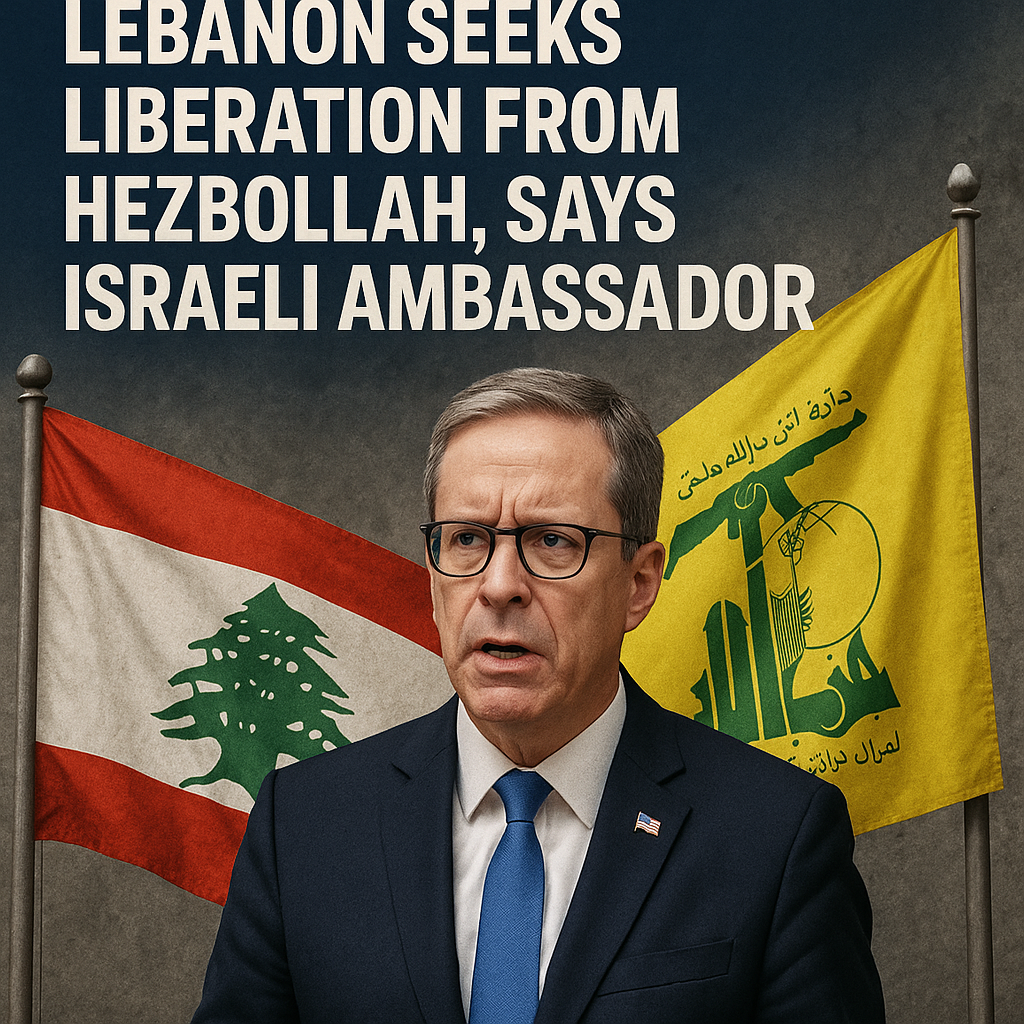
Lebanon Seeks Liberation from Hezbollah, Says Israeli Ambassador

Lebanon Seeks Liberation from Hezbollah, Says Israeli Ambassador
The complex landscape of Lebanese politics has come to the forefront with recent statements from Israeli officials regarding Hezbollah’s formidable influence in Lebanon. The Israeli ambassador has boldly claimed that Lebanon seeks liberation from what many perceive as Hezbollah’s overreach. This assertion opens up a multifaceted dialogue about sovereignty, national identity, and the implications this has for regional stability.

The Context of Hezbollah’s Influence
Hezbollah, established in the early 1980s, has evolved from a militia responding to Israel’s invasion into a dominant political and military force within Lebanon. The group is often viewed as an extension of Iranian influence in the region, complicating Lebanon’s internal affairs and its relationship with neighboring states. This complexity has been underscored by the dire economic situation Lebanon currently faces, which many have blamed on Hezbollah’s political maneuvers.


Economic Crisis and Discontent
As Lebanon grapples with one of the worst economic crises in its history, the sentiment among many citizens towards Hezbollah has shifted. Citizens are increasingly frustrated by rampant corruption and the lack of basic services. Reports show that the Lebanese pound has lost over 90% of its value since 2019, causing widespread poverty. In a country where Hezbollah is perceived to be hoarding power, discontent is bubbling to the surface.


This social unrest could be seen in the widespread protests that erupted in 2019, initially against the government’s tax proposals but quickly morphing into a broader condemnation of the political class, which many believe is heavily influenced by Hezbollah. Al Jazeera reported that many Lebanese citizens feel trapped by the group’s control, attributing their hardships to its political decisions.
Diverging Perspectives on National Sovereignty
While the Israeli ambassador’s assertion hints at a burgeoning desire for liberation among the Lebanese populace, reactions within Lebanon reveal a more nuanced reality. Some critics argue that Hezbollah’s presence actually provides a degree of stability in a country fraught with sectarian divisions. They contend that in the absence of Hezbollah, Lebanon could plunge into further chaos.
Conversely, opponents within Lebanon express a growing desire for autonomy and governance free from the group’s influence. A recent piece from RT highlighted how segments of the Lebanese population are beginning to voice their aspirations for a state that prioritizes national interests over sectarian loyalty. They are increasingly calling for political reforms that could potentially reduce Hezbollah’s sway.
A Divided Public Opinion
Public opinion about Hezbollah in Lebanon is decidedly mixed. Some view it as a legitimate resistance force against Israel, while others brand it a hindrance to national progress. According to recent surveys, some Lebanese citizens are even questioning the extent to which Hezbollah should engage in regional conflicts, suggesting a shifting focus towards nation-building rather than external warfare.
Julie, a young activist from Beirut, stated in a Sky News interview that her generation is tired of being used as pawns in global political games. “We just want to live our lives, free from the shadow of war and economic despair,” she lamented. This sentiment captures a growing rift between the older generation—who may still hold onto Hezbollah’s narrative of resistance—and younger people seeking a radically different future.
Potential Ramifications for Regional Stability
The Israeli ambassador’s claim, while provocative, highlights the underlying tensions present not just within Lebanon but also in the broader Middle Eastern political landscape. If the Lebanese public continues to push back against Hezbollah’s dominance, this could lead to significant geopolitical shifts. Hezbollah’s positioning ties closely to Iranian interests; any weakening of its grip could alter how Iran exercises its influence in the region.
Moreover, as Lebanon seeks to assert its sovereignty, the potential for conflict with Israel, as well as other regional players, remains a real concern. The delicate balance of power in the Middle East hinges on how Lebanon navigates its internal struggles while responding to external pressures.
Conclusion: Navigating Complexity
Lebanon’s situation is fraught with contradictions and diverse viewpoints. While the Israeli ambassador suggests a burgeoning desire for liberation from Hezbollah, many internal voices complexify this sentiment. The reality on the ground encompasses fears, aspirations, and the potential for both progress and conflict. As the Lebanese people strive for a path forward amid economic despair, their choices will not only define their nation’s identity but could reverberate throughout the region for years to come.
In an era marked by upheaval, one thing remains clear: the quest for liberation in Lebanon is as multi-dimensional as the forces that shape it.















