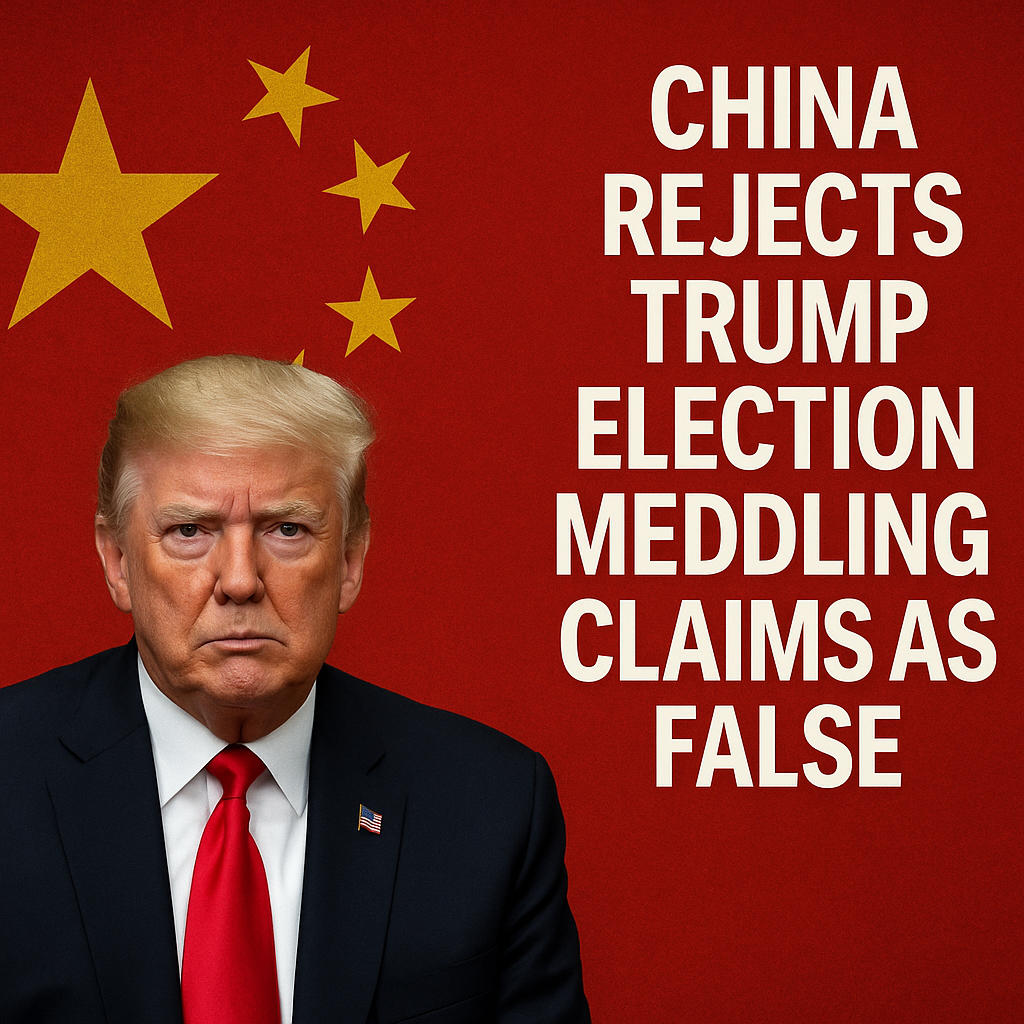
China Rejects Trump Election Meddling Claims As False
China has firmly rejected claims made by former President Donald Trump that it interfered in the 2020 U.S. presidential election. These assertions, according to various reports, have been dismissed as unfounded and a distraction from the actual challenges facing the U.S. political landscape.

Analyzing the Rejection of Election Meddling Claims
The Chinese Foreign Ministry’s response to Trump’s allegations highlights a broader strategy of Beijing to maintain its narrative in the battle of geopolitical influence. Wang Wenbin, a spokesperson for the ministry, emphasized that “the U.S. should reflect on its own issues rather than smear others.” This statement underscores China’s commitment to countering foreign accusations while reinforcing its position against what it describes as attempts to shift blame to external actors.

This reaction aligns with previous instances when Chinese officials have been quick to challenge Western narratives that paint China in a negative light. The political climate in the U.S., as seen along partisan lines, further complicates perceptions. For instance, a significant portion of Trump’s base sees conspiracy theories as plausible explanations for the election outcomes they oppose. This divisive scenario enables China to position itself as a victim of unfounded attacks rather than a perpetrator.

Divergent Perspectives on Claims of Interference
While Trump’s claims align with broader Republican sentiment about election integrity and foreign interference, many experts and analysts have voiced skepticism regarding the validity of these allegations. Reports from various sources highlight that no definitive evidence supports the notion that China played any significant role in manipulating the election results. Furthermore, national security and intelligence agencies within the U.S. have consistently found that interference was primarily tied to Russian efforts in the 2016 and 2020 elections, rather than any actions by China.
These contrasting views suggest a landscape where allegations are often weaponized for political gain, reflecting deeper divisions domestically. The narrative that Trump advances has been met with considerable pushback not only from Democrats but also from many Republicans who argue that promoting such claims without solid evidence may undermine democratic processes.
The Political Context and its Implications
Trump’s comments come at a time when his political future remains uncertain amid various legal challenges. By framing China as a meddler, he may be attempting to consolidate his base around a common enemy to distract from his personal challenges and galvanize support for his future endeavors, including a potential 2024 presidential run. This tactic—characteristic of Trump’s political strategy—highlights how allegations of foreign interference can serve as tools for domestic political maneuvering.
On the other hand, China stands to gain from this narrative conflict. By painting the claims as baseless, Beijing not only seeks to bolster its own image domestically but also aims to project an image of resilience and self-assuredness on the global stage. As the internal divisions in the U.S. become more pronounced, the global implications could lead to increasing skepticism about American democratic processes, potentially impacting international relations and trade dynamics.
Conclusion
The rejection of Trump’s election meddling claims by China represents a snapshot of the complex interplay between domestic U.S. politics and international relations. The responses from both sides of the aisle reflect a broader context of skepticism and accusation that often overshadows substantive discourse about foreign policy and election integrity. As this narrative unfolds, it becomes increasingly crucial to discern facts amid the rhetoric, allowing for a clearer understanding of both U.S. politics and the international arena.