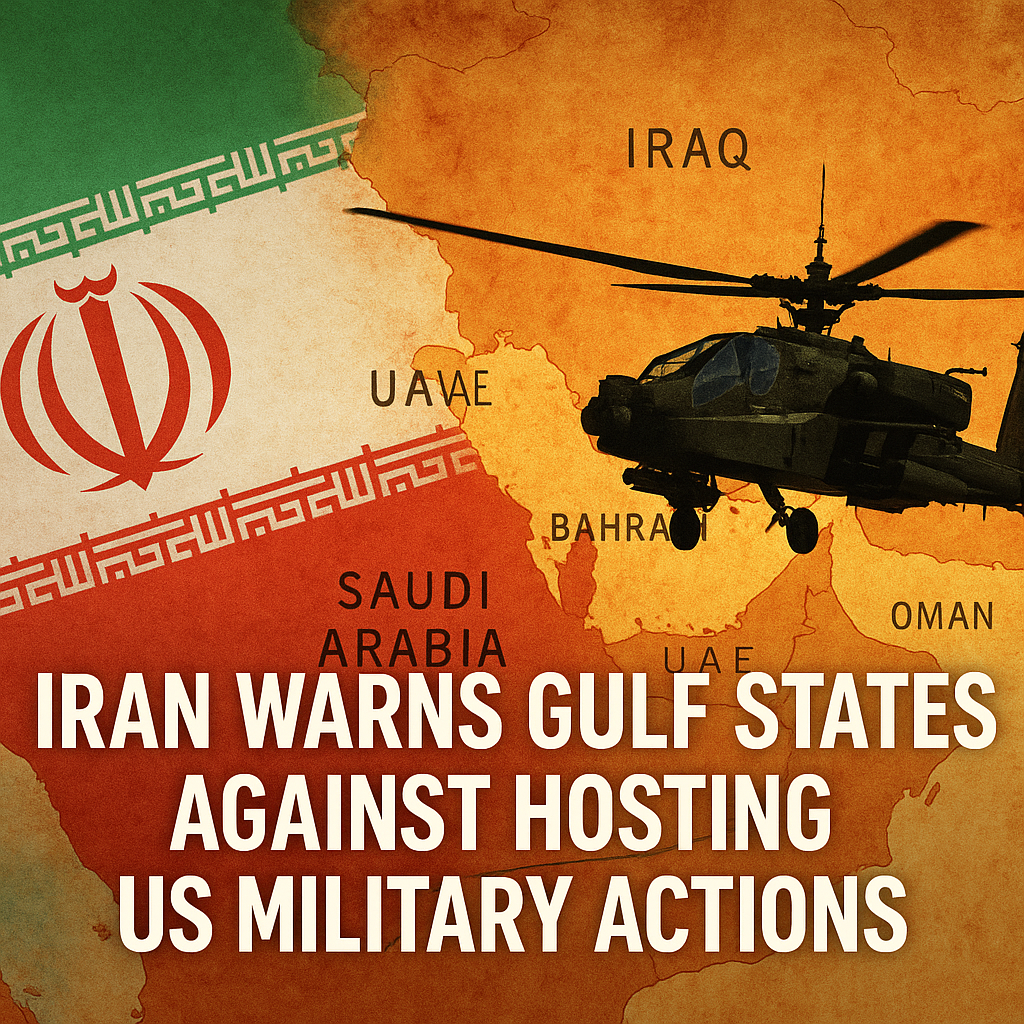
Iran Warns Gulf States Against Hosting US Military Actions
Iran Warns Gulf States Against Hosting US Military Actions
In a significant diplomatic gesture, Iran has issued a stern warning to Gulf states about the potential consequences of hosting U.S. military operations. This recent escalation in rhetoric underscores a complex web of regional security concerns, historical rivalries, and geopolitical strategies.

Escalating Tensions in the Persian Gulf
Iran’s warning comes on the heels of increasing military presence by the United States in the Gulf region, a development that Tehran views as a direct threat to its sovereignty. Iranian officials have articulated concerns that accommodating U.S. armed forces could lead to instability, asserting that Gulf states would be drawn into conflicts that do not serve their national interests.

In a statement, Iran’s Foreign Ministry emphasized that cooperation with the U.S. military “will not bring security” to these nations. This marks a continuation of Iran’s long-standing position that foreign military bases in the region exacerbate tensions rather than alleviate them. Tehran’s perspective is rooted in historical grievances stemming from Western influence in the Middle East, which many in the region perceive as neocolonial.

Divergent Views Among Gulf States
The reaction from Gulf states has not been monolithic. Some countries, notably Saudi Arabia and the UAE, have maintained or even bolstered their security partnerships with the U.S. in response to perceived threats from Iran. For these nations, the presence of U.S. forces is seen as a necessary counterbalance to Iranian influence and aggression in the region.
However, a subset of Gulf states has begun to contemplate a more neutral or even cooperative stance toward Iran. For instance, Oman and Kuwait have advocated for dialogue, arguing that military solutions will not resolve the underlying tensions. These nations recognize the importance of stability and are wary of being ensnared in a broader conflict that could result from increased U.S. military involvement.
The Global Context
The backdrop of this regional tension includes the ongoing fallout from the U.S. withdrawal from the nuclear agreement with Iran, known as the Joint Comprehensive Plan of Action (JCPOA). Since the U.S. withdrawal, Iran has pursued increasingly aggressive nuclear and military policies, leading to heightened alarm among its neighbors and the international community.
In light of these complexities, many analysts argue that the Gulf states face a delicate balancing act. On one hand, they must address their security concerns; on the other, they need to avoid becoming entrenched in a conflict driven by external powers. This tension presents a difficult challenge in diplomatic strategy, necessitating clear communication among regional players to prevent miscalculations that could lead to military escalation.
Conclusion
Iran’s warning serves as both a marker of its broader strategic concerns and a call for Gulf states to rethink their military alliances. As nations in the region navigate this complex landscape, the stakes are high; security decisions made today could have lasting ramifications for regional stability. Understanding these dynamics requires a careful examination of both the historical context and current geopolitical realities, illuminating the intricate relationships at play in the Persian Gulf. The ultimate question remains: Can regional actors find a path toward constructive dialogue, or will the specter of military confrontation prevail?