
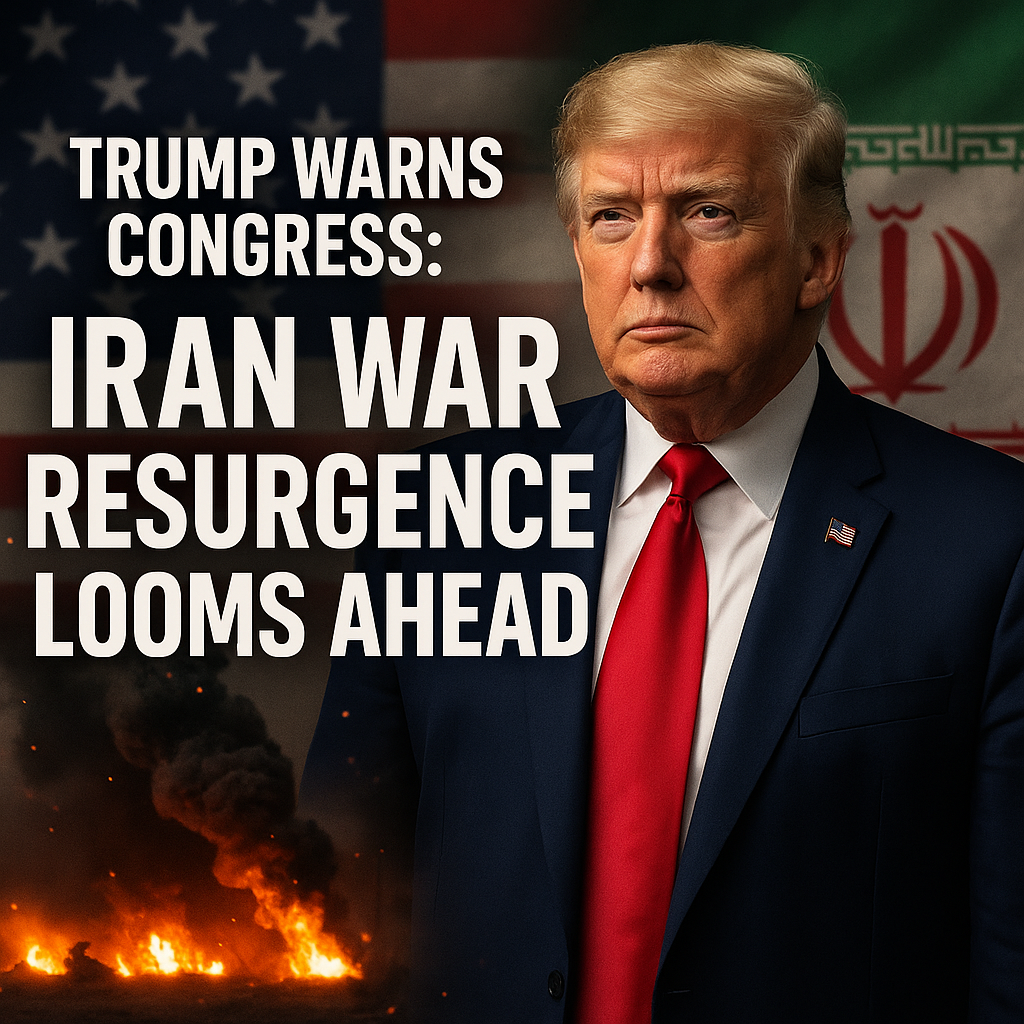
Trump Warns Congress: Iran War Resurgence Looms Ahead
Trump Warns Congress: Iran War Resurgence Looms Ahead
In recent discussions, former President Donald Trump has issued stark warnings to Congress about the potential resurgence of conflict with Iran. This sentiment resonates amid increasing tensions in the Middle East, as key players navigate a complex geopolitical landscape.

Understanding the Current Climate
The backdrop against which Trump’s warnings arise is critical to understanding the stakes involved. Multiple sources indicate that the U.S. and Iran have experienced heightened friction in recent months. Reports suggest that Iran has ramped up its military capabilities, specifically its nuclear program, which has sparked concerns among U.S. officials and allies alike. For instance, the International Atomic Energy Agency (IAEA) noted a substantial increase in uranium enrichment levels, raising alarms over Iran’s intentions.

Moreover, the Biden administration has faced challenges in its approach to Iran. Efforts to revive the Joint Comprehensive Plan of Action (JCPOA), originally agreed upon in 2015, have faltered, leading to skepticism about Iran’s commitment to a diplomatic resolution. Observers note that Trump’s warning serves not only as a call to Congress but also as a touchpoint for his supporters who favor a more aggressive stance on Tehran.

Divergent Perspectives on Military Engagement
Despite Trump’s bold assertions, opinions diverge among political leaders regarding military engagement with Iran. Some Republicans echo Trump’s apprehensions, advocating for a robust U.S. presence in the Middle East to counter Iran’s influence. They argue that a lack of decisive action could embolden Tehran, which has been known to leverage regional conflicts for expansionist aims. Conversely, several congressional Democrats caution against unnecessary military escalation, emphasizing diplomacy as a more prudent avenue forward.
The division is reflective of broader public opinion on military involvement. Data suggests that many Americans remain wary of entering another war in the Middle East, a sentiment that has been influenced by long-standing conflicts in Iraq and Afghanistan. This apprehension complicates Congressional action, as representatives weigh the implications of military intervention against constituent sentiment.
Potential Consequences of Inaction
Experts warn that failing to address the potential resurgence of tensions could have dire consequences. National Security Advisor Jake Sullivan recently highlighted the repercussions of a possible Iranian nuclear arsenal, calling it “a threat to global peace.” Yet, the challenge remains: balancing proactive measures with the need to avoid conflict.
Trump’s statements could thus serve two purposes—mobilizing political support for preemptive strikes and underscoring the urgency for some form of action before military options become limited. Observers are concerned that a lack of robust response may lead to further emboldenment of Iranian proxy groups across the Middle East, from Hezbollah in Lebanon to Houthi rebels in Yemen, triggering a wider regional conflict.
Conclusion: What Lies Ahead?
As Congress grapples with Trump’s warnings against the backdrop of escalating tensions with Iran, it finds itself at a crossroads. While some advocate for a return to aggressive military strategies from previous administrations, others stand firm in their belief that diplomacy must lead the way. The differing perspectives illustrate not only the complexities of U.S.-Iran relations but also the broader implications for U.S. foreign policy moving forward.
With various stakeholders—politicians, military leaders, and the public—holding differing views on how to approach the situation, the resolution remains unclear. What is certain, however, is that the future of U.S.-Iran relations will continue to be shaped by ongoing discussions in Congress and the evolving geopolitical landscape.















