
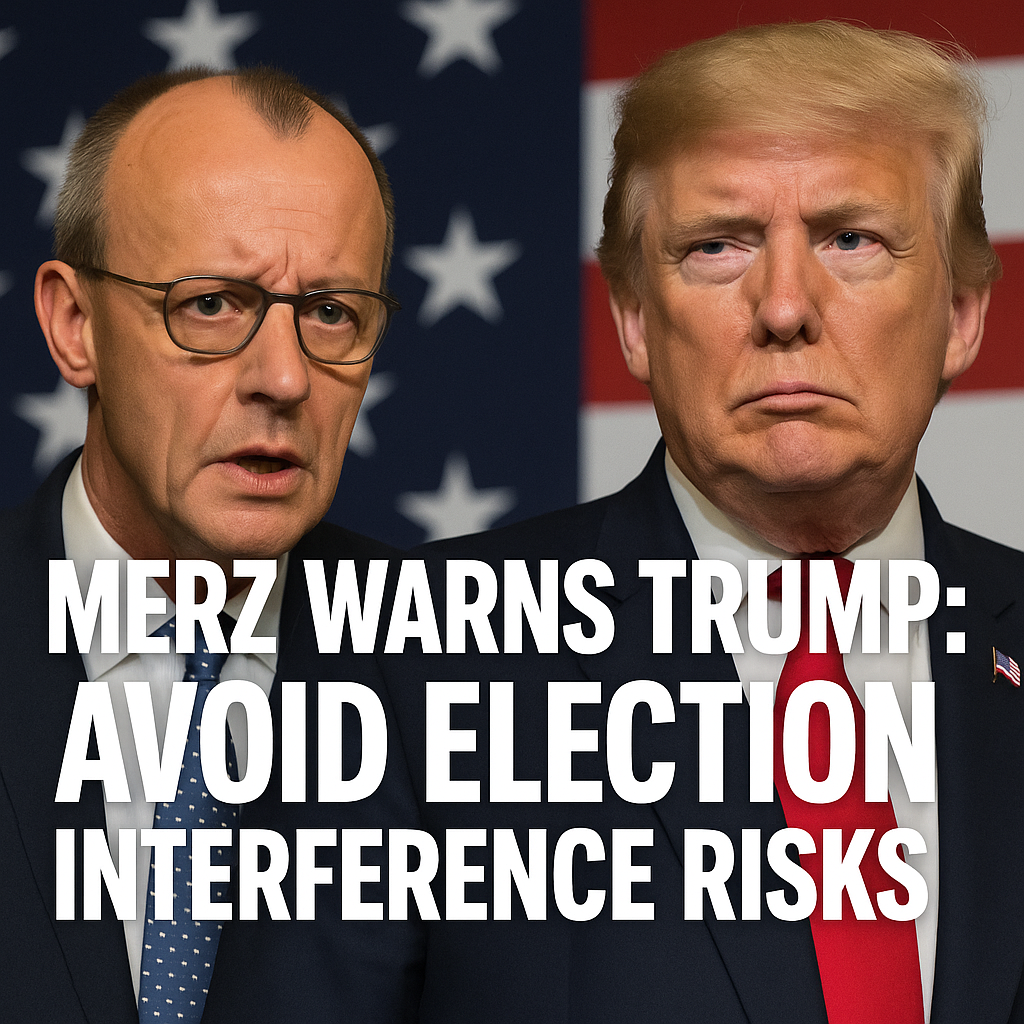
Merz Warns Trump: Avoid Election Interference Risks
Election Integrity and Accountability: Merz’s Warning to Trump
In a recent statement highlighting the dangers of political interference, German politician Friedrich Merz cautioned former U.S. President Donald Trump about the risks associated with meddling in electoral processes. This warning underscores a growing concern among global leaders regarding the integrity of elections, especially as the 2024 presidential race approaches.

Understanding the Political Landscape
Merz, the leader of Germany’s Christian Democratic Union (CDU), expressed his apprehensions in response to the ongoing legal troubles faced by Trump, including potential election interference allegations. His comments carry weight not only due to his political stature but also given Germany’s historical context and commitment to democratic values.

The notion of election interference is not isolated to the United States; it draws parallels across various democracies scrutinizing the integrity of their electoral systems. The German politician underscored the necessity of maintaining clean, transparent elections as a hallmark of democracy. Echoing sentiments from various global leaders, Merz articulated the broader implications of political figures undermining electoral processes, suggesting it may erode public trust in democracy itself.

Diverse Perspectives on Election Interference
While Merz’s warning primarily addresses Trump, it reveals a widespread anxiety concerning the future of democratic practices. An array of commentators offers differing views on the implications of such interference. Some suggest that the U.S. must take serious steps to protect its electoral framework, pointing to historical instances of challenges seen in previous elections, like those during the 2020 election cycle.
Conversely, there are voices that argue too much focus on election interference may detract from other pressing issues facing U.S. society, such as economic disparity and social justice. They highlight that while accountability is crucial, politicizing every election-related action can create division and distraction from substantive policy discussions.
Both perspectives present a complex tableau; one emphasizes the necessity for vigilance against threats to democratic processes while the other warns against hyper-focusing on election dynamics that might lead to further political fragmentation. Engaging with this duality is vital for understanding the multiple layers of the political discourse surrounding democracy today.
The Broader Implications of Election Interference
The recent discourse initiated by Merz presents a critical juncture for not only the U.S. but global democracy at large. Election integrity is viewed as a universal objective, positioned at the heart of democratic societies. When influential leaders voice concern over potential electoral sabotage, it raises alarm bells that resonate beyond national borders.
Consequences of perceived election fraud or misconduct can be profound:
– Erosion of Trust: Allegations or evidence of interference can lead to significant public skepticism regarding the legitimacy of elected officials.
– Polarization of Society: Divisive narratives surrounding elections can amplify societal split, urging citizens into ideological camps rather than fostering dialogue.
– International Relations: A country struggling with electoral integrity may find its international reputation tarnished, complicating relations with allies and affecting global cooperation on important issues.
Merz’s warnings advocate for a universal vigilance against practices that threaten electoral fairness. He insists that democratic integrity should be non-negotiable, a sentiment that resonates in discussions surrounding governance worldwide.
Conclusion: A Call for Vigilance
As Friedrich Merz warns Donald Trump against the potential risks of election interference, the broader implications of his message serve as a reminder of the collective responsibility towards democratic integrity. The dialogue surrounding election transparency continues to evolve, and it is crucial for all stakeholders to engage with the complexities this issue entails.
The intersection of legal challenges, public trust, and international perspectives forms a rich landscape for discussion. The stakes might seem inherently national, yet the ramifications extend globally, requiring a closer examination and, perhaps more importantly, actionable commitment to preserve democratic values.















