
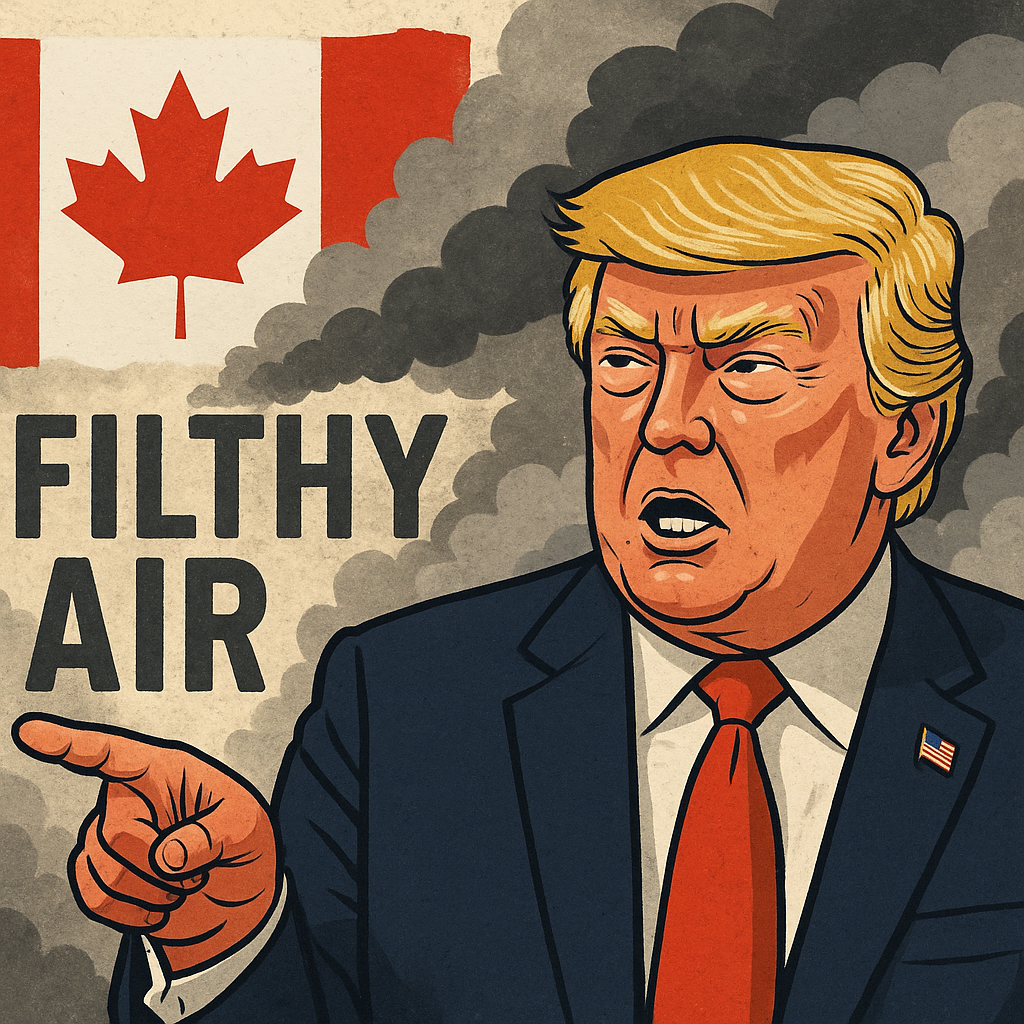
Trump Blames Canada for US ‘Filthy Air’ Invasion
In a recent and controversial statement, former President Donald Trump attributed the poor air quality affecting parts of the United States to wildfires in Canada, referring to the influx of smoke and pollutants as an “invasion” of “filthy air.” This comment has sparked a debate about the environmental and political implications of such assertions, especially in the context of cross-border environmental responsibility.

The Context of Air Quality Concerns
The assertion that Canada is responsible for the deteriorating air quality in parts of the United States is not entirely speculative. As wildfires raged across vast regions of Canada, substantial smoke was indeed reported to drift across the border, leading to hazardous air quality levels in several U.S. states. According to the U.S. Environmental Protection Agency (EPA), air quality alerts were issued in areas as far south as New York due to an influx of wildfire smoke from the north. This situation led to criticism of how authorities address wildfire management and air quality monitoring across both nations.

However, experts argue that attributing the issue solely to Canada oversimplifies a multifaceted challenge. Air pollution does not recognize national boundaries, and many factors contribute to air quality, including local sources of pollution, climate change, and atmospheric conditions. For instance, urban smog and emissions from automobiles and industries play a significant role in air quality issues within the U.S. itself. Thus, while Canadian wildfires contribute to the current scenario, they are part of a larger, more complex web of factors.

Contributions to Wildfire Conditions
Wildfires have become increasingly prevalent in North America due to climate change, which has led to prolonged periods of drought and elevated temperatures. A report from Al Jazeera pointed to these overarching climate patterns that exacerbate wildfire conditions. This contemporary increase in wildfire activity, particularly in western Canada and the United States, highlights the urgent need for a comprehensive approach to fire management, including better forest management practices and more robust climate change mitigation strategies.
Additionally, many scientists emphasize that the intensity and frequency of wildfires are indicative of a changing climate. As such, discussions about air quality must encompass broader environmental policies addressing greenhouse gas emissions and the role of fossil fuels, which remain a core component of both Canadian and U.S. economies.
The Political Ramifications
Trump’s comments tap into a larger narrative of scapegoating neighboring countries for domestic issues—an approach that can resonate politically among certain voter demographics but overlooks cooperative solutions for environmental issues. His statement seemed designed to rally his base around a familiar theme: blaming external factors for internal challenges. However, it raises questions about the effectiveness of political leadership in addressing collaborative environmental challenges.
Reactions to Trump’s statements have been mixed. Supporters may see his comments as a rallying cry to prioritize domestic air quality issues, while critics argue that such rhetoric can further strain U.S.-Canada relations, which have generally relied on collaborative environmental management strategies. Intergovernmental agreements have long been in place to address shared environmental issues, from air quality to water management, underscoring the importance of cooperation rather than confrontation.
Finding Common Ground
In the wake of these disaster-driven air quality events, there is a rising call for policies that reinforce both countries’ commitments to reducing emissions while improving wildfire management. Some experts advocate for innovative strategies such as controlled burns, improved forest management, and investment in renewable energy technologies to mitigate the conditions leading to intense wildfires.
Furthermore, international environmental agreements, such as the Paris Agreement, could become central to addressing the climate challenges exacerbating wildfire activity. By working collaboratively, the U.S. and Canada can pursue shared strategies rather than falling into the trap of blame gaming.
Conclusion
While it is true that Canadian wildfires have contributed significantly to air quality challenges in parts of the United States, attributing the situation solely to Canada oversimplifies a critical and complex issue. With air quality being more than just a matter of localized incidents, informed discussions must look beyond national borders to address the underlying factors driving environmental concerns. Trump’s remarks have served to highlight the urgent need for nuanced conversations around climate policy, international cooperation, and proactive measures to protect the environment in face of growing climate threats.















