
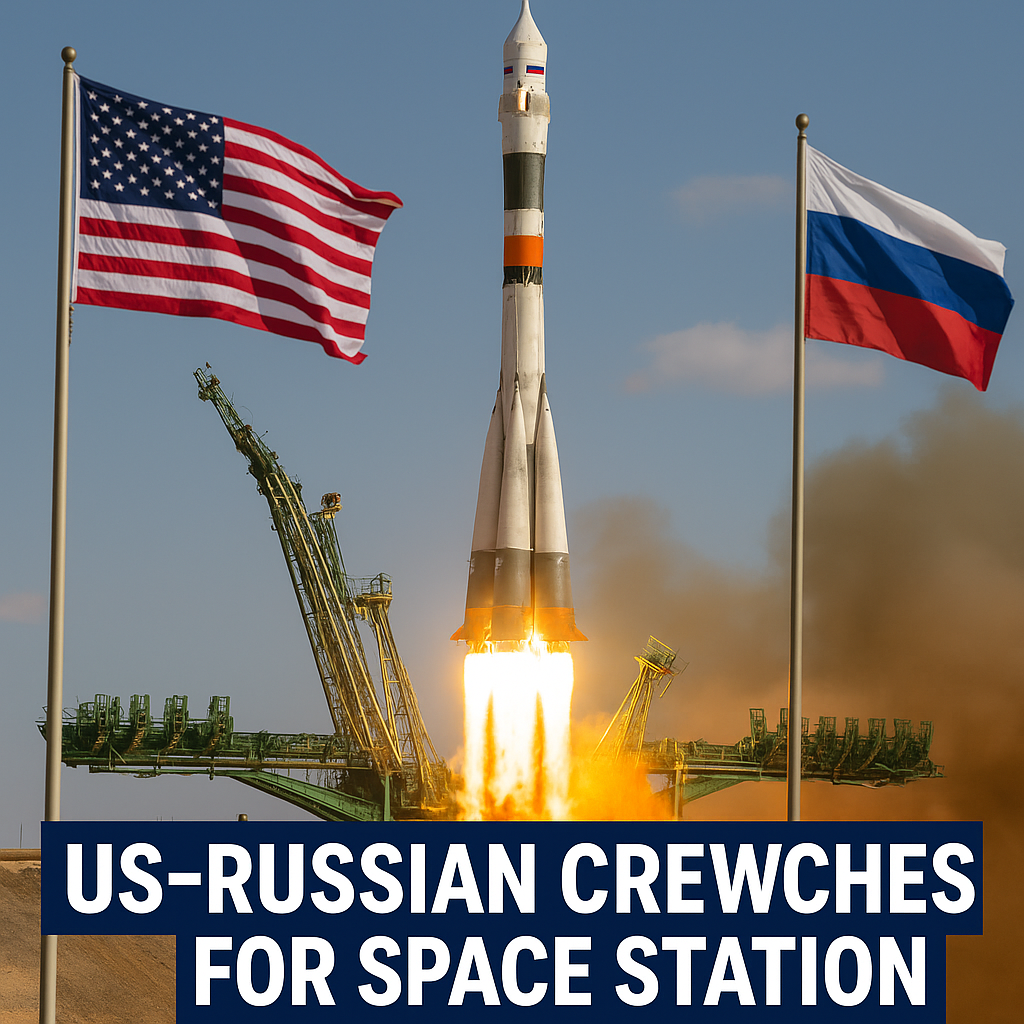
US-Russian Crew Launches for Space Station Mission
US-Russian Crew Launches for Space Station Mission
In a historic display of international cooperation, a joint US-Russian crew successfully launched for a mission to the International Space Station (ISS). This milestone represents not only a technical achievement but also a fragile bridge in the complex tapestry of US-Russian relations.

A Milestone in Space Cooperation
On the morning of July 14, 2026, the launch commenced from Baikonur Cosmodrome in Kazakhstan, with the spacecraft carrying three crew members: two cosmonauts from Russia and one astronaut from NASA. This mission is part of a longstanding tradition of cooperation in space exploration, dating back to the Cold War era when the Apollo-Soyuz Test Project brought together astronauts from both nations in a series of groundbreaking joint missions.

Sources suggest that the current geopolitical tensions between the US and Russia have made such collaborative efforts increasingly rare. While both countries have cooperated historically in space, recent years have seen diverging paths, particularly in the areas of politics and defense. However, this mission signals a temporary pause in those divisions, emphasizing a shared commitment to scientific inquiry and human exploration of the cosmos.

Diverse Perspectives on Space Diplomacy
The launch has evoked different responses both in Western media and in Russian outlets. Al Jazeera highlights the symbolic nature of the mission, framing it as a potential thawing of previously frozen diplomatic ties amid rising hostilities. The collaboration is particularly poignant during a time when joint ventures in other fields may face significant obstacles.
Conversely, Russian state media outlet RT presents a slightly different angle, focusing on the technical prowess and resilience of the Russian space program. They emphasize how the successful launch of the crew not only showcases Russia’s engineering capabilities but also reinforces its status as a major player in the global community of space exploration—regardless of the geopolitical strains.
Key points regarding the mission include:
– The spacecraft’s design and engineering, attributed to decades of collaborative efforts between NASA and Roscosmos.
– The significance of maintaining human presence aboard the ISS, which is crucial for ongoing research into various fields, including biology, physics, and environmental science.
– The potential for future missions, which may further incorporate collaborative endeavors with international partners.
The Human Factor
Underpinning this mission are the astronauts themselves, whose personal stories interweave the broader narrative of US-Russian collaboration. As they prepare for an extended stay at the ISS, their training together highlights the potential for unity even amidst discord. This human element resonates widely, as families and friends express pride in their loved ones’ accomplishments in what is often described as the highest form of teamwork.
Moreover, the astronauts have expressed a keen understanding of their roles as not just representatives of their respective nations, but as participants in a larger, shared human experience. In an age where global challenges such as climate change demand unified action, the mission serves as a reminder that shared goals can sometimes transcend political divides.
Future Challenges Ahead
Despite the positivity surrounding this mission, uncertainties remain. The geopolitical landscape continues to shift, and many analysts speculate that challenges lie on the horizon. Critics warn that even successful missions like this could ultimately be undermined if diplomatic relations take a turn for the worse.
Moreover, funding in the space sector is often subject to the fluctuations of political agendas. A successful mission could inspire further collaboration; however, any significant deterioration in US-Russian relations may lead to the suspension of future joint efforts, leaving the ISS to continue operating with a fragmented international crew.
Conclusion: A Symbol of Hope
The launch of the US-Russian crew marks a significant chapter in the story of international space exploration. While it is an emblem of hope and collaboration, it also serves as a reminder of the intricate geopolitical dynamics intertwined with what could be one of humanity’s most unifying endeavors: space exploration.
As nations face various challenges on Earth, this mission brings to light the necessity of collaboration—both in space and beyond. The crew’s journey to the ISS is not only about exploration but also a demonstration of what can be achieved when countries come together, even if only momentarily, to tackle the great challenges facing humanity.















