
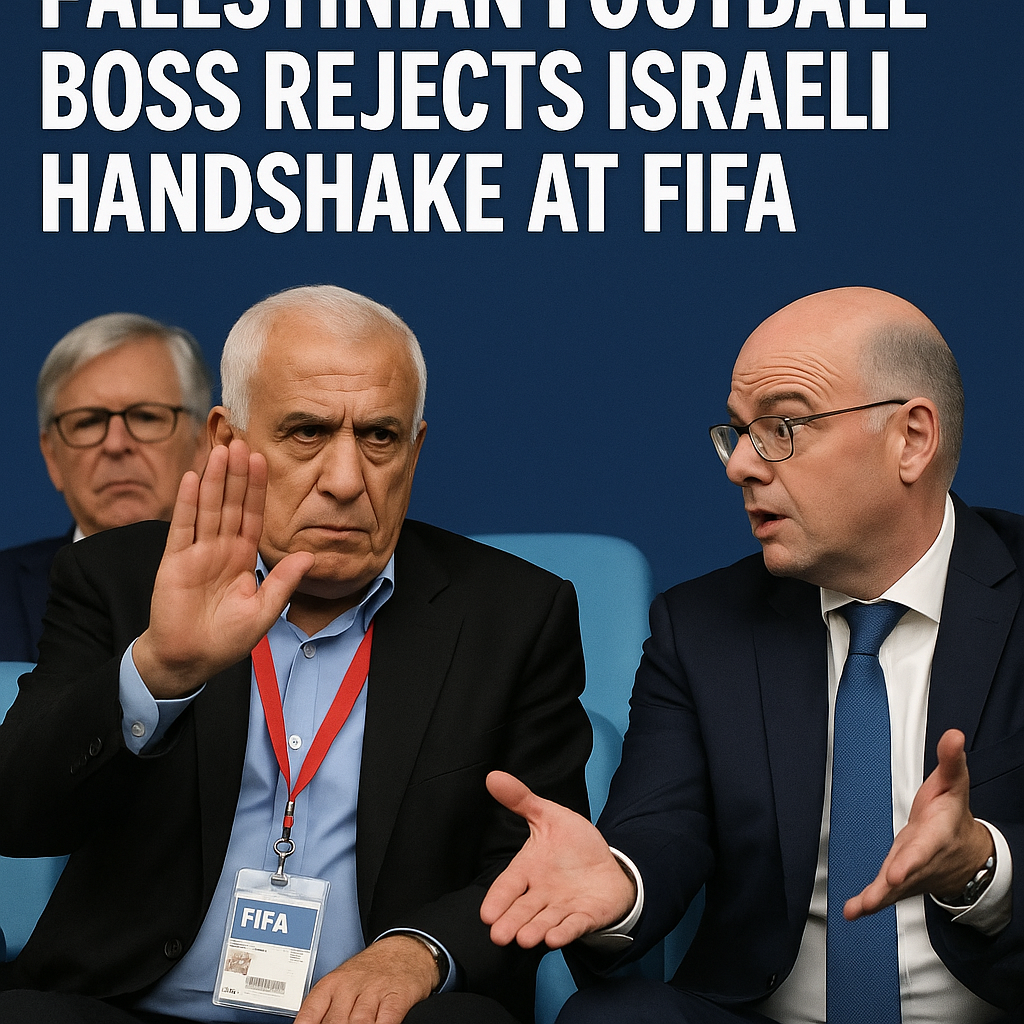
Palestinian Football Boss Rejects Israeli Handshake at FIFA

Palestinian Football Boss Rejects Israeli Handshake at FIFA
The world of football often serves as a microcosm of broader geopolitical tensions, illustrating the complexities of relationships between nations. Recently, a notable incident at a FIFA event has highlighted the ongoing discord between Palestinian and Israeli representatives, particularly as Palestinian Football Association President Jibril Rajoub publicly rejected an Israeli handshake during a high-profile gathering.

The Incident: A Stand for Solidarity
The rejection of the handshake by Rajoub occurred during FIFA’s recent Annual Congress, where various football officials gathered to discuss the future of the sport. According to multiple reports, including significant coverage from Al Jazeera, Rajoub’s refusal to engage in the traditional greeting was more than just a display of personal sentiment; it was a symbolic act denoting the larger Palestinian struggle for recognition and rights within the realm of sports and beyond.


Rajoub stated, “We will not shake hands until there is justice for our people.” His sentiment echoes the frustrations felt by many Palestinians regarding what they perceive as ongoing oppression and marginalization. The stance was met with a range of reactions from other officials, illustrating the polarizing nature of the Israeli-Palestinian conflict even within sporting communities.


Diverse Reactions from the Global Community
Responses to Rajoub’s refusal have spanned a spectrum of emotions and opinions. Many supporters hailed his decision as a courageous stand for Palestinian rights, while critics argued that such actions may further entrench divisions rather than promote dialogue. For instance, a Sky News report highlighted that some Israeli officials expressed disappointment, interpreting the handshake as a potential step towards normalization and shared understanding between the two sides.
Contrasting viewpoints illustrate that while Rajoub’s actions may resonate with those advocating for Palestinian rights, they may also be seen as counterproductive by individuals hoping for diplomatic engagement through sports. In a world increasingly seeing sports as a platform for peace and reconciliation, the incident raises essential questions about the role of athletes and officials as ambassadors for their nations.
The Broader Context of Sports and Politics
This incident is not an isolated event; it sits at the intersection of sports and international politics, where emotions run high and actions are laden with significance. Football, in particular, has often been wielded as a tool for both unity and division. Events like FIFA’s World Cup can offer opportunities for countries to display their identities on a global stage, yet they can also provoke nationalistic sentiments that exacerbate existing tensions.
Reports indicate that Rajoub has a history of using his platform to voice concerns about Israeli policies affecting Palestinian athletes. He has been vocal about travel restrictions and limitations on training facilities that hinder the development of Palestinian football. His recent actions may, therefore, be seen as part of a broader campaign aimed at bringing attention to these issues.
Striking a Balance: The Role of Dialogue
Amid the heated discussions, it is essential to consider whether such incidents exacerbate existing rifts or pave the way for more meaningful dialogue. Football, often viewed as a universal language, poses both challenges and opportunities for conflict resolution. When figures like Rajoub refuse to engage in gestures typically seen as diplomatic, they challenge both supporters and opponents to reassess their approaches to the dialogue.
Conversely, some argue that the refusal to engage can alienate potential supporters who may be sympathetic to Palestinian issues but are discouraged by acts perceived as unwillingness to collaborate. It raises the question: how can sports serve as a bridge rather than a barrier in politically charged environments?
Conclusion: The Path Forward
The recent handshake incident involving Rajoub exemplifies the frequently complicated relationship between politics and sports. As the Palestinian Football Association and Israeli representatives navigate their complex relationship on- and off-the-field, it remains clear that gestures of solidarity and diplomacy are fraught with risks and rewards.
Finding a middle ground may be challenging, but it is essential if football is to remain a source of hope and rapprochement. The discourse surrounding this incident is a reminder of the need for continued dialogue and awareness of the historical context that shapes the actions of individuals within the sport. Balancing advocacy with opportunities for engagement could provide pathways toward greater understanding, potentially transforming football from a battleground for rivalry into a platform for peace.















