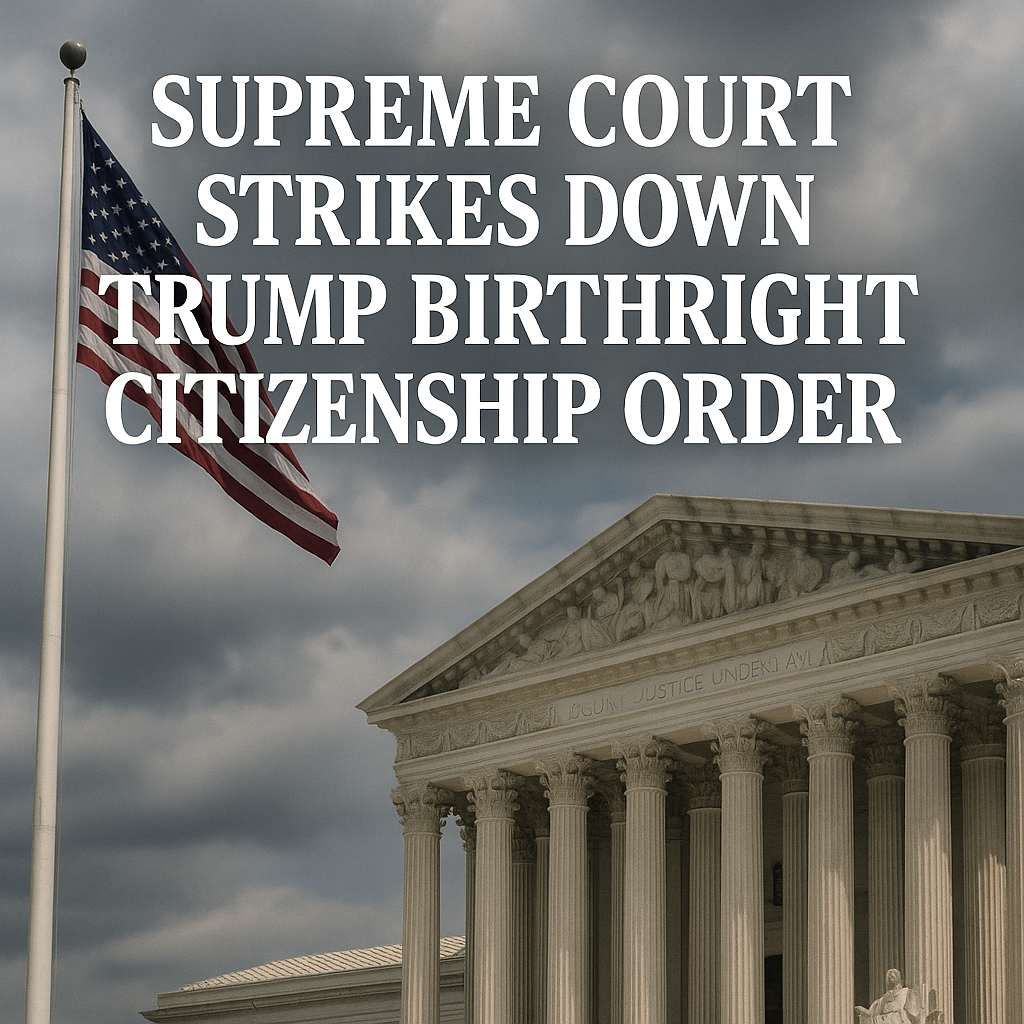
Supreme Court Strikes Down Trump Birthright Citizenship Order

Supreme Court Strikes Down Trump Birthright Citizenship Order
The recent decision by the Supreme Court to strike down former President Trump’s order concerning birthright citizenship has reignited a crucial debate surrounding immigration and the rights of individuals born on U.S. soil. This ruling underscores the complexity of citizenship laws and the lasting impact presidential directives can have on American policy.

Historical Context of Birthright Citizenship
Birthright citizenship in the United States has roots in the 14th Amendment, ratified in 1868, which states, “All persons born or naturalized in the United States, and subject to the jurisdiction thereof, are citizens of the United States.” The Supreme Court’s ruling aligns with the longstanding legal interpretation that affirms this principle, which has been a fundamental aspect of American citizenship law for over a century.


The Trump administration had sought to alter this status quo with its controversial executive order, aiming to limit citizenship rights based on parents’ immigration status. This attempt was portrayed as a measure to control undocumented immigration, yet it faced significant pushback from civil rights advocates and legal experts who argued it contradicted established legal norms.


Diverse Perspectives on the Ruling
Opinions surrounding the Supreme Court’s decision reflect a broader societal divide. Proponents of the ruling view it as a necessary defense of constitutional rights. They argue that the decision safeguards the essential fabric of democratic privileges granted to all individuals born in the U.S., regardless of their parents’ immigration status.
For instance, legal analysts have noted that the ruling reinforces a historic norm, highlighting the importance of a clear and consistent application of citizenship laws. In a statement that resonates with many proponents, an attorney involved in the case emphasized, “The citizenship of a child should not be contingent upon the immigration status of their parents.”
Conversely, critics of the ruling underscore its implications for immigration policy and national security. Some argue that the Trump administration’s efforts were rooted in a concern for preserving resources and forms of welfare for citizens. They believe that relaxing birthright citizenship could ease perceived burdens on social services. However, this viewpoint often relies on assumptions that undocumented immigrants disproportionately strain these resources—a claim that is frequently contested by research indicating otherwise.
The Implications of Uncertainty
While the Supreme Court’s decision is definitive, it also leaves a multitude of questions regarding the future of immigration policy. Uncertainties loom about how this ruling will influence local and state laws, as various jurisdictions may respond differently in terms of their immigration enforcement tactics and policies concerning citizenship.
Moreover, the political landscape is likely to be affected significantly. With immigration remaining a hot-button issue, both major political parties may use the ruling to fuel their respective narratives. Some Democrats might leverage this moment to advocate for broader immigration reform, emphasizing the need to protect the rights of all individuals born in the U.S., while Republicans may continue to push for stricter immigration controls.
Moving Forward: A Complex Landscape
The striking down of Trump’s birthright citizenship order illustrates not only the robust mechanisms of checks and balances within American government but also the nuanced debates that characterize immigration discourse. As America grapples with its identity and the complexities of a diverse society, the ruling serves as a reminder of the ongoing tensions between immigration control and a commitment to human rights.
Ultimately, the larger implications derived from this decision remain to be observed, particularly concerning the political maneuvers that may follow. Citizens and lawmakers alike must engage in constructive dialogue aimed at understanding these issues more deeply, with the hope of fostering policies that reflect the fundamental values of equity and justice inherent to the U.S. system. The road ahead will likely be fraught with challenges, yet it also presents an opportunity for meaningful discourse on what citizenship means in a changing world.