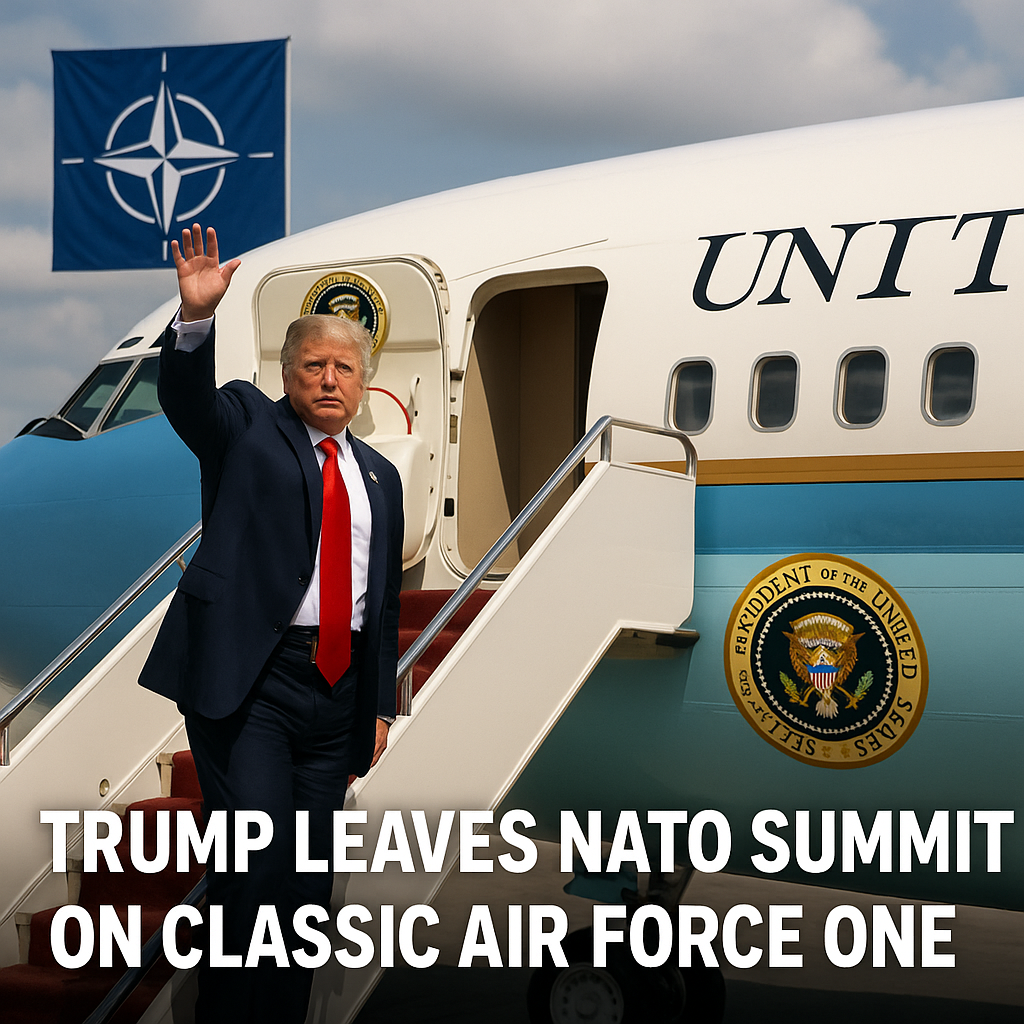
Trump Leaves NATO Summit on Classic Air Force One

Trump Leaves NATO Summit on Classic Air Force One
The recent departure of former President Donald Trump from the NATO summit aboard the classic Air Force One has sparked discussions on both the symbolism of the aircraft and the former President’s relationship with the NATO alliance. This departure encapsulates more than just a transition from a summit; it reflects broader themes of national and international sentiment.

A Symbol of Legacy
Air Force One is not just an aircraft; it represents the power and prestige of the presidency. Trump’s choice to leave NATO on the older model, rather than the more modern variant, raises interesting questions about legacy and diplomacy. Critics argue that the decision may symbolize a departure from traditional U.S. diplomatic norms, as Trump’s tenure was marked by a somewhat tumultuous relationship with NATO allies. The classic aircraft serves as a reminder of a different era in U.S. foreign policy—one that prioritized solidarity among Western allies.


In one article from Al Jazeera, analysts indicated that Trump’s relationship with NATO was fraught with tension, particularly due to his occasional verbal assaults on member countries regarding defense spending. The utilization of the older Air Force One could be seen as a metaphor for Trump’s approach to International Relations—one that often favored a unilateral or transactional style over collaborative diplomacy.


Conversely, supporters argue that the use of the older aircraft is a nod to American history and a celebration of traditional values. In a political landscape increasingly polarized by ideas of globalization and American isolationism, this departure could symbolize a reclaiming of national identity in a world fraught with complex international interdependencies.
The Diplomatic Undertones
Leaving a NATO summit—a platform for dialogue and joint decision-making—on a symbolic aircraft fuels broader implications about U.S. roles in global governance. NATO, founded in 1949, has long stood as a pillar of collective defense and mutual support among its members. In reports from Sky News, analysts point out that Trump’s leadership style and rhetoric often sowed divisions within the alliance, contradicting its foundational principles of unity.
The reactions to Trump’s departure from the summit illustrate a division in public opinion regarding the effectiveness of NATO under U.S. leadership. Critics emphasize that neglecting transatlantic relationships poses risks for collective security, particularly in light of emerging threats like cyber warfare and geopolitical tensions with nations like Russia. Such concerns bring to the forefront questions about the reliability of the U.S. as a leader in international coalitions—an issue that has been highlighted prominently in several editorial pieces across various publications.
On the other hand, proponents of Trump’s presidency often cite a re-evaluation of how NATO allocates resources as necessary for modernizing the alliance. They argue that the U.S. should prioritize its own security interests over those of others, thereby framing the departure as a strategic move rather than a careless negligence of diplomatic relations.
A Nuanced Farewell
As Trump departs from the NATO summit on that venerable aircraft, multiple viewpoints surface regarding the implications of his actions. While some view it as a symbolic departure from long-standing alliances, others interpret it as a reflection of changing priorities within the U.S. Administration.
Ultimately, whether Trump’s actions are read as an isolated incident or a representation of a broader trend in U.S. politics may depend on the observer’s perspective. As global dynamics continue to evolve, the implications of such symbolic gestures may resonate in unexpected ways.
In conclusion, while the Air Force One departure serves as a focal point for ongoing debates about the U.S. role in international security, the true implications of Trump’s approach to NATO—and to alliances at large—remain to be seen. The dialogue sparked by this moment underscores the complexity of international relations, where actions often carry more weight than words.