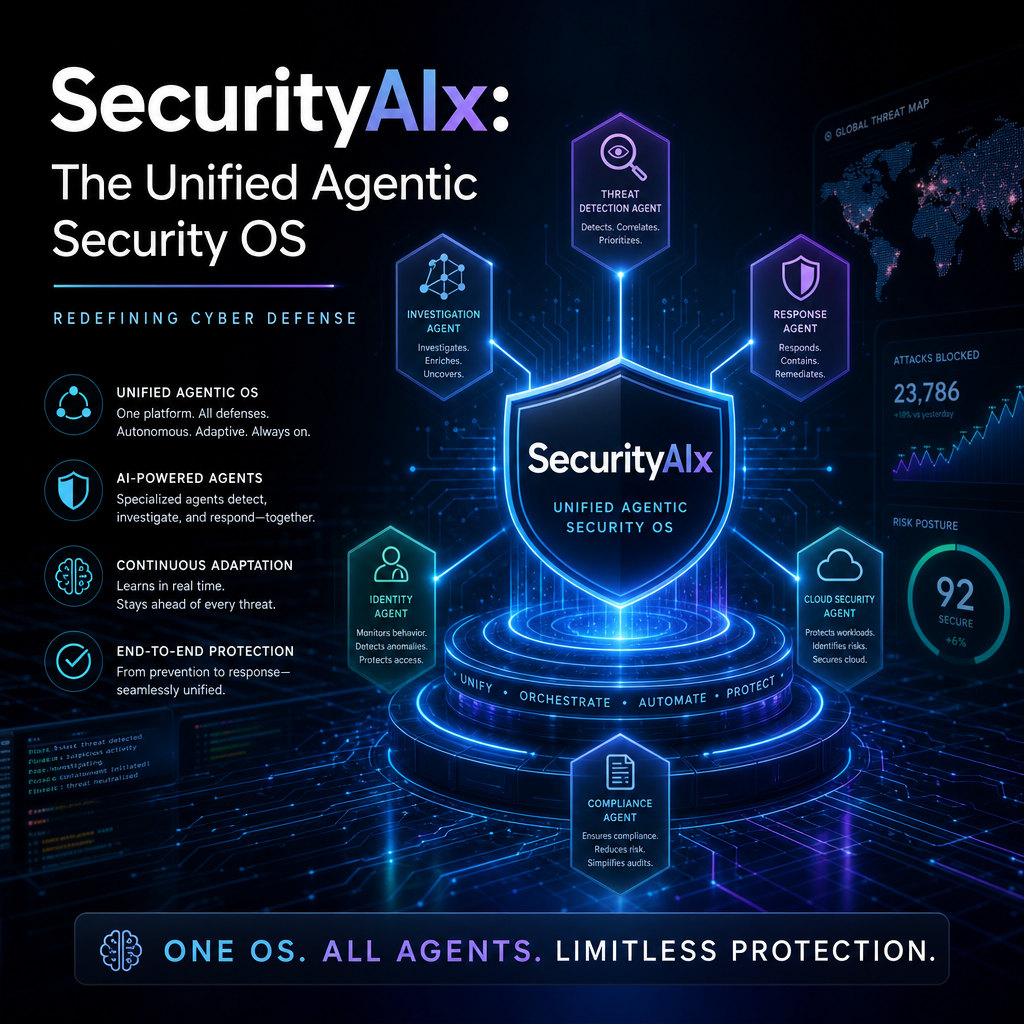
SecurityAIx: The Unified Agentic Security OS Redefining Cyber Defense
Why SecurityAIx Is Redefining Cyber Defense: The Rise of the Unified Agentic Security OS
Cyber defense is changing fast. Threats move in seconds, attack surfaces keep expanding, and security teams are expected to do more with fewer people. In this environment, traditional tools that operate in silos are no longer enough. This is where SecurityAIx is drawing attention as a new kind of security platform: a unified agentic security OS built to coordinate, automate, and accelerate defense across the entire security lifecycle.

Rather than adding yet another point solution to an already crowded stack, SecurityAIx aims to bring detection, investigation, response, and remediation into one intelligent operating layer. That shift matters because modern defense is no longer just about seeing threats. It is about acting on them quickly, consistently, and with context.

The Problem with Fragmented Security
Most organizations today rely on a mix of tools for endpoint protection, cloud visibility, identity security, SIEM, SOAR, and threat intelligence. Each tool may be powerful on its own, but together they often create friction.

Common challenges include:
- Alert overload and duplicated signals
- Manual triage across disconnected systems
- Slow response times during active incidents
- Gaps in context between identity, endpoint, and cloud events
- Heavy dependence on overworked analysts
This fragmentation can delay action and increase the chance that a real attack slips through. Security teams spend too much time stitching together data instead of stopping threats.
What Makes SecurityAIx Different
SecurityAIx is redefining cyber defense by treating security as an orchestrated system rather than a collection of isolated products. The idea behind a unified agentic security OS is simple: let intelligent agents work across tools, data sources, and workflows to make security operations faster and more adaptive.
A unified approach to security operations
Instead of forcing analysts to jump from dashboard to dashboard, SecurityAIx centralizes the operational layer. It can correlate signals from multiple sources, prioritize what matters, and trigger the right response steps automatically.
Agentic intelligence in action
The “agentic” part is important. It means the platform is not just passively reporting alerts. It is designed to take context-aware actions, such as:
- Enriching alerts with relevant threat data
- Mapping suspicious activity to attack chains
- Recommending or executing containment steps
- Coordinating remediation across teams and systems
This creates a more proactive model of defense, where the platform behaves less like a reporting tool and more like a security operator.
Why the Unified Agentic Security OS Matters
A unified agentic security OS offers more than convenience. It changes how organizations build resilience.
Faster detection and response
When data is unified and actions are automated, the time between detection and containment shrinks dramatically. That can make the difference between a blocked intrusion and a full-scale breach.
Better decision-making
SecurityAIx helps reduce noise by connecting events across the environment. A login anomaly, a suspicious endpoint process, and a cloud privilege escalation may look minor separately. Together, they may reveal a coordinated attack. The platform’s value comes from making these patterns visible.
Less manual workload
Analysts are often buried in repetitive tasks like enrichment, validation, and ticket routing. A unified agentic model removes much of this manual burden so teams can focus on higher-value investigations and strategic improvements.
Stronger collaboration
Cyber defense involves multiple stakeholders, from SOC analysts and threat hunters to incident responders and IT operations. By serving as a shared security layer, SecurityAIx helps align these groups around a common operational picture.
Practical Benefits for Modern Security Teams
Organizations adopting SecurityAIx-style architecture are typically looking for measurable gains. The most important ones often include:
- Reduced mean time to detect
- Reduced mean time to respond
- Improved alert quality
- Greater visibility across hybrid environments
- More consistent incident handling
- Scalable operations without linear headcount growth
These outcomes are especially valuable for mid-sized and enterprise teams managing large cloud footprints, remote endpoints, and distributed identities.
The Shift from Tools to Systems
For years, cybersecurity grew by accumulation. Teams added tools to solve new problems, but the stack became harder to manage over time. The rise of the unified agentic security OS signals a different direction: security as a coordinated system.
That shift mirrors what happened in other parts of enterprise technology. Businesses moved from standalone software to integrated platforms because platform-level thinking improves speed, visibility, and control. Cybersecurity is reaching the same point.
SecurityAIx represents that evolution by combining intelligence, orchestration, and automation into a single operating model. It is not just helping teams handle alerts. It is helping them build a more responsive defense architecture.
The Future of Cyber Defense
As attackers become more automated and more persistent, defenders need systems that can keep pace. Human expertise will always matter, but it must be amplified by platforms that can process information and act at machine speed.
That is why SecurityAIx stands out. It reflects a future where cyber defense is not fragmented, reactive, or overly manual. Instead, it is unified, agentic, and built for continuous response.
In short, the rise of the unified agentic security OS is more than a product trend. It is a new model for how security teams can defend modern infrastructure with greater speed, clarity, and confidence.