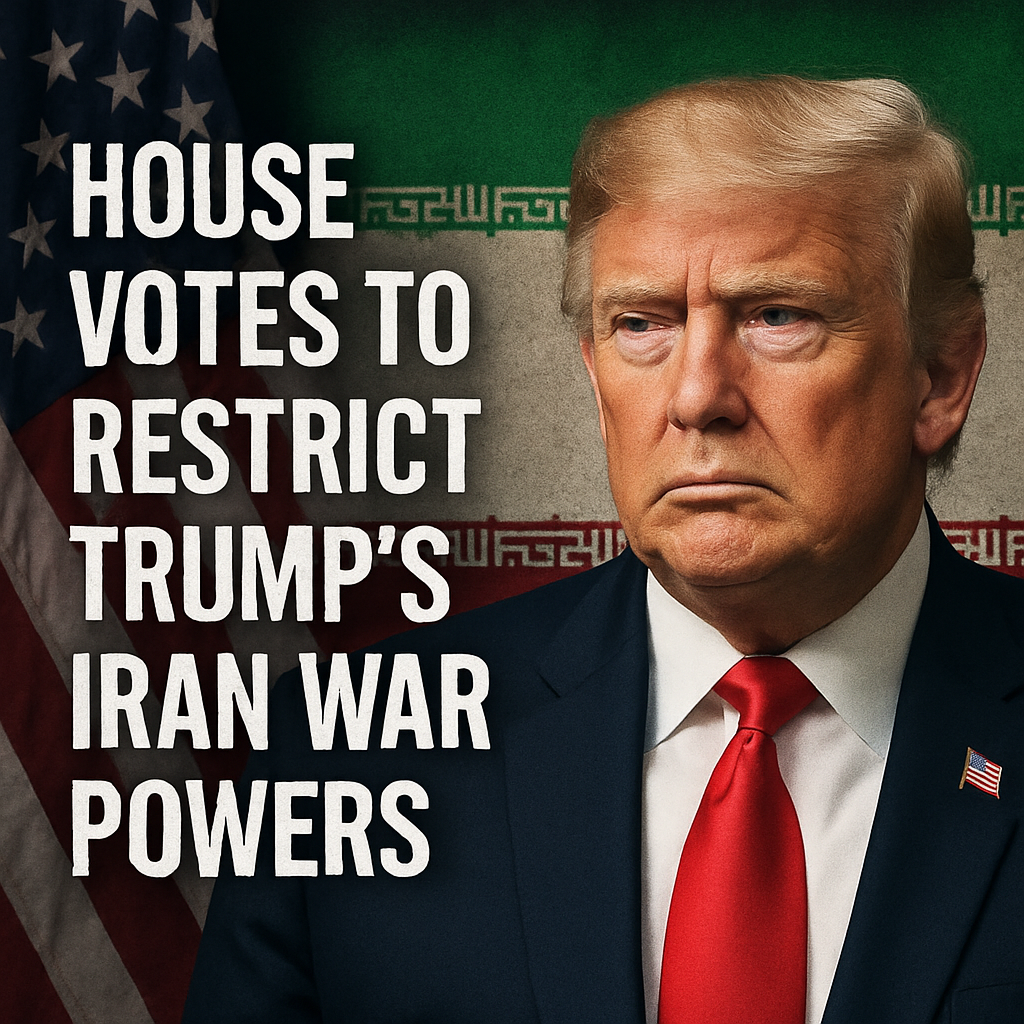
House Votes to Restrict Trump’s Iran War Powers

House Votes to Restrict Trump’s Iran War Powers
In a significant political maneuver, the House of Representatives has voted to restrict the war powers of former President Donald Trump regarding Iran. This decision has stirred a complex debate over executive authority and military engagement, reflecting deep divisions in Congress and among the American public.

Understanding the Vote
The House’s recent vote is framed as a response to concerns about the executive branch’s unchecked power to initiate military actions without congressional approval. Proponents argue that such constraints are necessary to prevent inadvertent escalation into conflict, especially given the volatile nature of U.S.-Iran relations.


This vote follows a long-standing legislative effort aimed at increasing congressional oversight of military actions. The resolution passed largely along party lines, with Democrats advocating for the restrictions while most Republicans opposed the measure, viewing it as an infringement on presidential powers. Representative Ro Khanna, a vocal advocate for the resolution, emphasized the importance of this check on power, stating, “No president should unilaterally be able to send our troops to war without congressional approval.”


Divided Perspectives
While the House’s decision aims to safeguard democratic processes, it has elicited varied responses from lawmakers and experts alike. Critics of the resolution argue that restricting the president’s war powers could hinder U.S. national security interests. They contend that swift military action may sometimes be necessary to respond to threats, particularly in a region as unpredictable as the Middle East.
Experts from Al Jazeera highlight that Iran has been increasingly aggressive in its regional influence, supporting proxies and militias across the Middle East. In this context, opponents of the House vote believe that limiting military action could embolden Iran, undermining U.S. efforts to contain its influence.
In contrast, many advocates for the restriction view it as a protective measure designed to prevent unnecessary conflict. They reference the long history of military engagements in the Middle East that began without clear congressional authorization, arguing that public sentiment largely supports a more cautious approach to military intervention.
The Role of Public Opinion
Polling data reveal a significant divide among American voters regarding this issue. A substantial number of citizens indicate a preference for Congress to have a more significant role in foreign military decisions. Many Americans are wary of continuing the cycle of military engagement in the Middle East, with various surveys showing that a majority believe that military action should be a last resort, supported only by extensive Congressional debate.
This divide raises essential questions about the future of U.S. foreign policy. While some political leaders advocate for a strong military presence to counter perceived threats, the public’s increasing demand for accountability suggests a potential shift toward more deliberative governance regarding war powers.
Conclusion: Striking a Balance
The House vote to restrict Trump’s war powers concerning Iran underscores a crucial tension in U.S. politics — the balance between executive power and legislative oversight concerning military engagement. As the political landscape continues to evolve, it remains to be seen how these developments will influence future relations with Iran and broader Middle Eastern policy.
The question of how we approach military action, particularly in a region fraught with historical complexities and geopolitical tensions, calls for careful consideration. Striking a balance between responding effectively to threats and ensuring that military actions receive appropriate oversight will likely remain a contentious issue in U.S. politics moving forward.