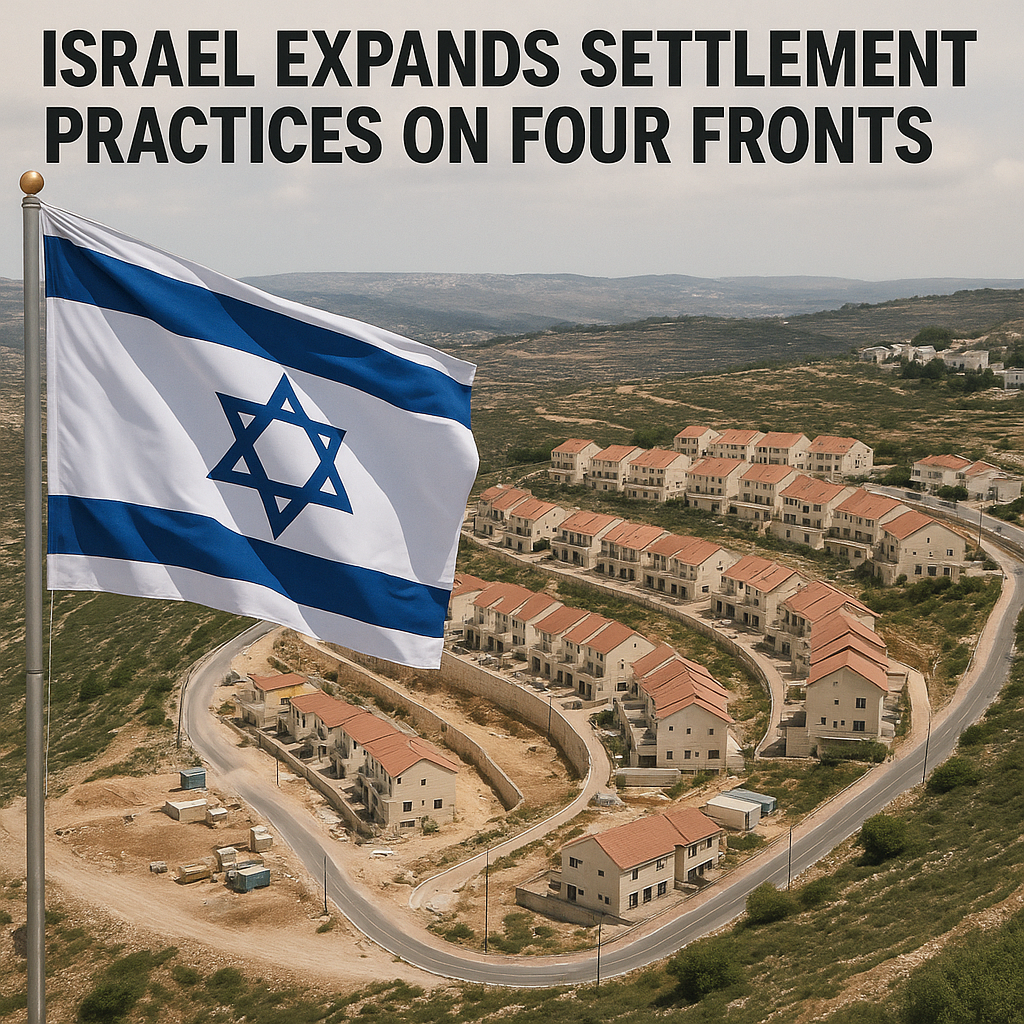
Israel Expands Settlement Practices on Four Fronts

Israel has recently expanded its settlement practices on multiple fronts, a move that has drawn both regional and international scrutiny. The ongoing policies surrounding Israeli settlements have always been complex, and the current developments illustrate the intricate interplay of politics, security, and historical claims to land.

The Expansion of Israeli Settlements: An Overview
Settlement activities in the West Bank, East Jerusalem, and territories surrounding the Golan Heights have seen noticeable increases, despite ongoing protests from Palestinian communities and condemnation from various international bodies. Reports indicate that these expansions are occurring simultaneously in several areas, leading to rising tensions and uncertainty in the region.


Settlements in the West Bank and East Jerusalem
In the West Bank, Israel continues to construct new homes in settlements, which many experts argue violate international law. According to Al Jazeera, the Israeli government has recently approved plans for thousands of new housing units in areas that are considered highly contentious. This expansion not only alters the demographic landscape but also complicates any potential resolution to the Israeli-Palestinian conflict.


Settlements in East Jerusalem, where a significant Palestinian population resides, further exacerbate tensions. Numerous Palestinian families face the threat of eviction, often justified under the pretext of legal ownership claims by Israeli settlers. These practices raise ethical questions regarding rights and justice for both Palestinians and Israeli settlers, leading to ongoing disputes over land ownership.
The Golan Heights and Its Strategic Significance
Furthermore, Israel’s actions in the Golan Heights also contribute to the complicated narrative surrounding settlement expansion. As noted in reports from RT, Israel is accelerating settlement construction in this strategically important area, claiming that it bolsters national security. The historical context of the Golan Heights, which has been under Israeli control since the 1967 Six-Day War, adds another layer to the conflict, with regional players, including Syria, vehemently opposing these developments.
The continuation of settlement expansion in the Golan can be interpreted as Israel’s assertion of sovereignty, but it also raises the question of the long-term implications on Israel’s relations with neighboring countries. Each announcement of newly approved settlements is likely to invoke strong reactions, highlighting the fragile nature of peace in the region.
International Responses: A Divided World
The international community remains divided on the issue of Israeli settlements. Many Western nations, including the United States, have expressed concerns about the legality and morality of these expansions but have often refrained from taking definite action. Consequently, the Israeli government appears undeterred. Domestic politics in Israel play a significant role, where hardline factions, bolstered by supportive constituencies, advocate for aggressive settlement policies.
In stark contrast, various organizations and nations advocate for harsher repercussions against Israel over its settlement expansions. The United Nations has condemned these practices, labeling them as potential violations of international law. This dissonance within the international community reflects a broader ideological divide regarding the Israeli-Palestinian relationship and the path forward.
The Human Impact: Voices from the Ground
While political maneuvering continues on a global scale, the human implications of these settlement expansions cannot be overlooked. Palestinians living in affected areas often experience displacement, loss of livelihood, and increased military presence, predominantly viewed as oppressive by many local and international observers. As detailed by reports from Sky News, stories of residents facing eviction highlight the human toll in addressing geopolitical issues.
On the ground, Palestinians are not merely statistics; they are families, businesses, and individuals coping with the realities of occupation and settlement construction. The emotional and psychological impact of these developments influences daily life, often leading to a sense of hopelessness among local communities.
A Complex Path Forward
The ongoing expansion of Israeli settlements is not merely a unilateral action but a multi-faceted issue with historical, political, and human dimensions. Moreover, as boundary lines continue to blur through settlement practices, the prospects for peace and resolution become increasingly daunting.
Concerns persist regarding the path forward, as efforts from both Israeli representatives and Palestinian authorities to negotiate peace often appear stymied by the reality on the ground. Whether these expansions will lead to increased tensions or motivate a renewed effort towards dialogue remains a critical uncertainty.
In conclusion, the expansion of Israeli settlements continues to be a deeply polarizing issue, emblematic of larger conflicts in the region. As various stakeholders weigh their actions and responses, the human dimension of this struggle remains paramount, reminding all involved that beyond politics, policies have real consequences for real people.