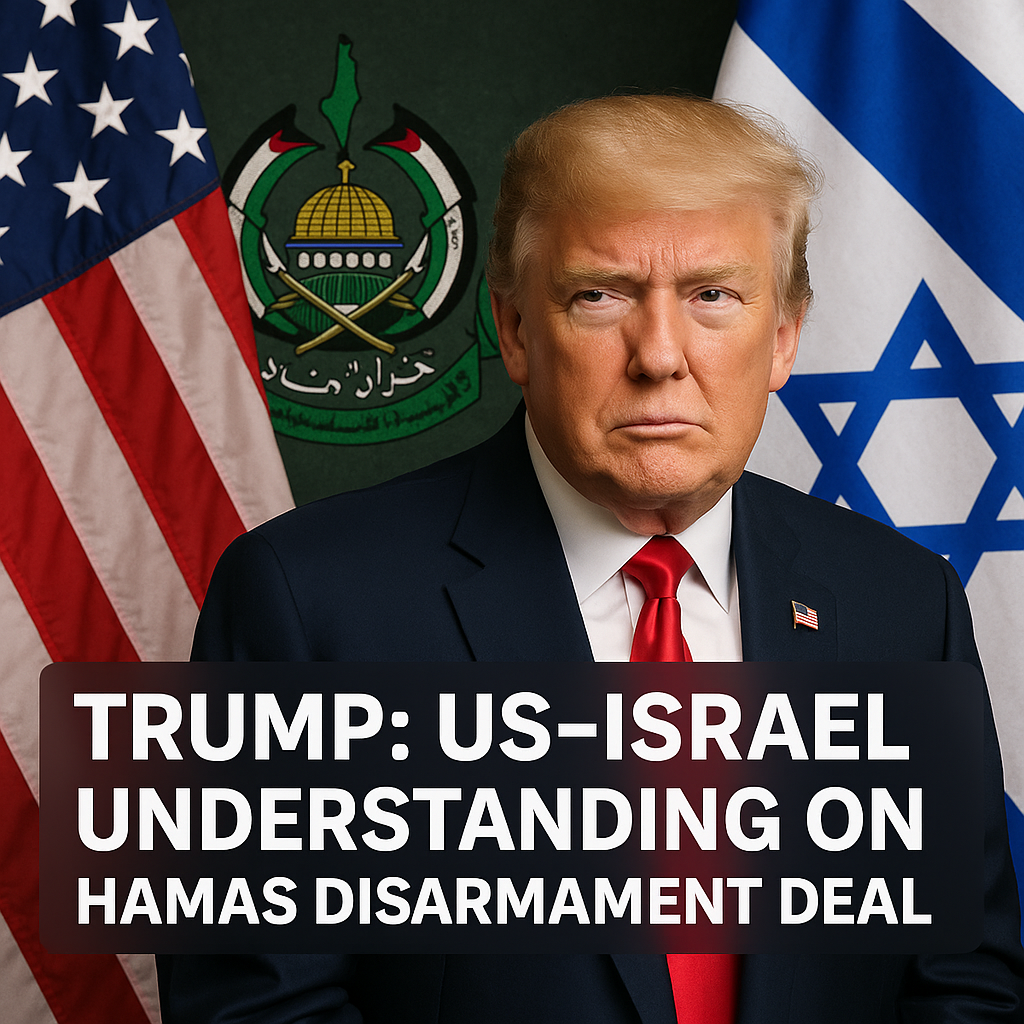
Trump: US-Israel Understanding on Hamas Disarmament Deal
H2: Understanding the Framework of the US-Israel Deal on Hamas Disarmament

Recently, former President Donald Trump claimed that the United States has reached an understanding with Israel concerning a disarmament deal focused on Hamas. This development opens up a dialogue about the intricacies of this agreement and its possible ramifications on both regional stability and international relations. The details surrounding this assertion warrant careful examination, especially given the differing perspectives among stakeholders in the region.

H3: The Foundations of Trump’s Claims

In Trump’s statements, he emphasized the strategic alliance between the U.S. and Israel as a driving force behind this purported agreement. According to reports, the framework includes measures aimed at curbing Hamas’ military capabilities, thereby enhancing Israel’s security landscape. This assertion aligns with historical U.S. policy, which has consistently supported Israel’s right to defend itself against threats.
However, the substantial geopolitical implications raise questions. Palestinian leaders have voiced skepticism, suggesting that such agreements could undermine their position and exacerbate the ongoing conflict. A Republican U.S. official described the context as an “increased focus” on Hamas that signals a shift in diplomatic engagement. Still, many critique this narrative, contending it oversimplifies a deeply entrenched struggle characterized by varying perspectives that include significant humanitarian considerations.
H3: Diverse Reactions to the Proposed Deal
While Trump’s administration may see this understanding as a positive step towards regional stability, responses have been mixed. Some analysts argue that a robust disarmament deal could pave the way for long-term peace, provided it is framed within a broader strategy that includes Palestinian representation and interests. Conversely, others caution against viewing disarmament in isolation. They highlight that without addressing the root causes of the Israeli-Palestinian conflict, such agreements may only provide temporary respite, fostering resentment among Palestinians.
Notably, reactions within Israel itself have been multifaceted. While the ruling government appears to be in favor of any measure that could weaken Hamas, voices from opposition parties caution against unilateral approaches that might alienate broader segments of the Palestinian population. The fear is that any perceived abandonment of dialogue could entrench divisions further, complicating future peace efforts.
H3: The International Perspective and Future Implications
The international community is watching closely as developments unfold. Many countries view a U.S.-Israel understanding on Hamas disarmament as a pivotal moment that could either bolster cooperation or instigate further tensions in an already volatile region. As such, Trump’s claims have sparked a range of discussions among foreign governments and organizations. Some fear that this strategy may prioritize Israeli security over humanitarian principles, risking further destabilization.
As experts in international relations weigh in, the consensus seems divided. Some believe that strong U.S. support for Israel could deter aggression from Hamas and neighboring factions. Others highlight the necessity for a balanced approach that includes legitimate Palestinian rights as part of any sustainable agreement.
In light of this complexity, it’s crucial to consider the broader implications of these developments. Should the understanding between the U.S. and Israel significantly alter the dynamics with Hamas, it would require serious ongoing negotiations to ensure that all parties feel represented and secure.
In conclusion, while Trump’s announcement of a U.S.-Israel understanding on Hamas disarmament frames the discussion around security measures, it is vital to recognize the intricate web of sentiments, reactions, and potential consequences that accompany such diplomacy. The future hinges not just on agreements, but also on fostering dialogue that paves the way for genuine coexistence.