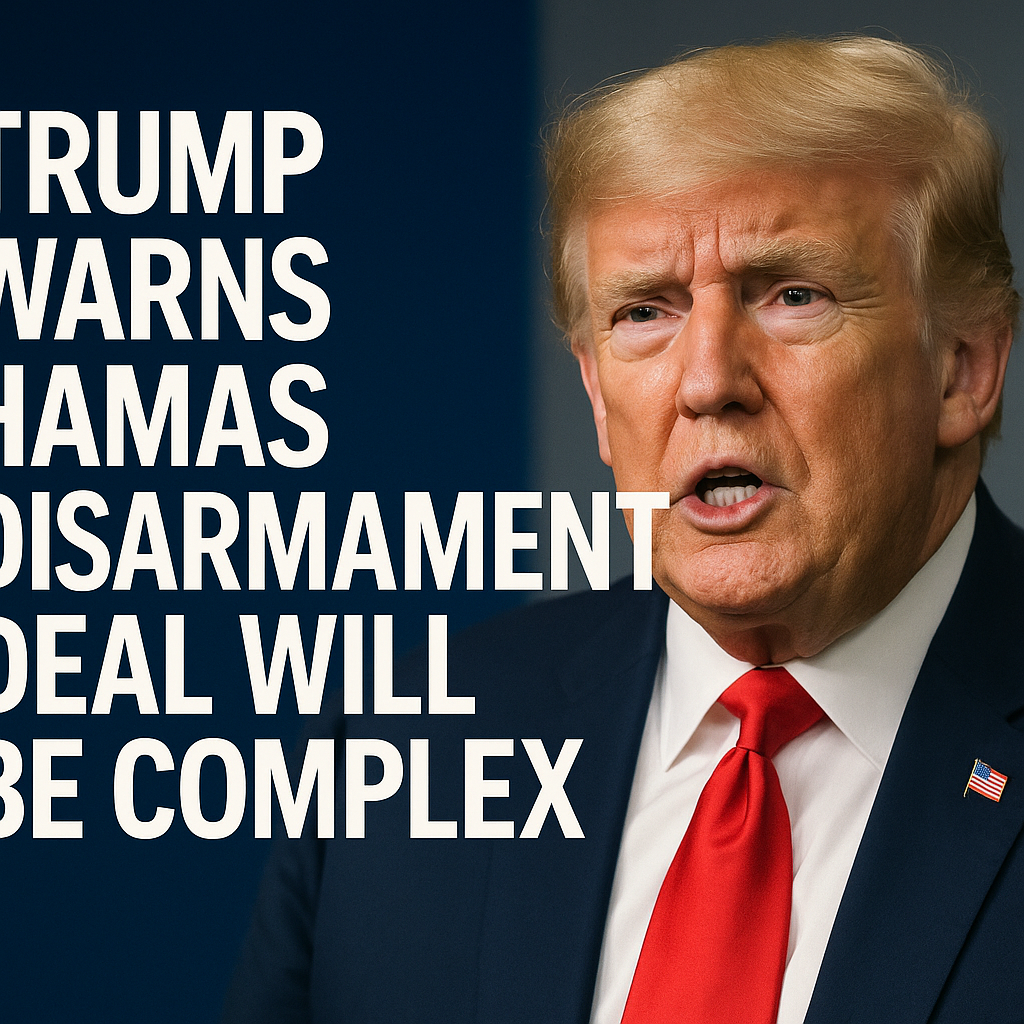
Trump Warns Hamas Disarmament Deal Will Be Complex
Understanding the Complexity of a Hamas Disarmament Deal
Former President Donald Trump recently expressed skepticism regarding the potential for a successful disarmament deal with Hamas, describing it as “complex to deliver.” This statement reflects broader concerns about the entrenched nature of conflicts in the Middle East, highlighting the difficult terrain any international negotiation processes must navigate.

The Historical Context of Hamas and Disarmament
Hamas, a militant Palestinian organization, has been central to the Israeli-Palestinian conflict for decades. Formed in 1987, the group has maintained a dual identity: part political entity and part armed resistance organization. The organization’s military wing, the Izz ad-Din al-Qassam Brigades, has been heavily involved in armed confrontations with Israel, complicating any negotiations aimed at disarmament.

The historical reluctance of Hamas to relinquish its arms is rooted in its perception of existential threats, particularly from Israel. For many Palestinians, Hamas represents resistance against occupation; thus, disarmament is not merely a political maneuver but a core identity principle. This dynamic raises significant questions: Can a disarmament deal that simultaneously addresses the concerns of both Hamas and Israel be realistically achieved?

International Perspectives on the Disarmament Debate
Trump’s remarks echo sentiments expressed by various international actors who caution against underestimating the complexities involved in negotiating with Hamas. On one side, there are those who believe that disarmament is essential for peace. Supporters of this view argue that without disarmament, any semblance of lasting peace will remain elusive. They emphasize the need for strong incentives—possibly economic aid or political recognition—to persuade Hamas to disarm voluntarily.
Conversely, critics of this perspective argue that disarmament could destabilize Hamas, leading to a power vacuum that other extremist groups might exploit. They propose that disarmament should be part of a broader peace framework that includes Palestinian statehood, security guarantees for Israel, and international involvement to ensure compliance.
The Role of International Actors
The future of any potential disarmament deal will likely rest on the engagement of international players. Nations such as Egypt and Qatar have acted as mediators in previous ceasefires and negotiations between Israel and Hamas. Additionally, the Arab League and the United Nations could play critical roles in framing discussions aimed at disarmament. Analysts suggest that without a collaborative approach, any attempt to disarm Hamas risks failure.
Furthermore, Trump’s warning serves as a reminder that political posturing can influence the environment surrounding these discussions. His administration’s previous policies toward the Israeli-Palestinian conflict, such as the recognition of Jerusalem as Israel’s capital, have already complicated diplomatic efforts. Such developments create a context in which disarmament negotiations might be viewed with skepticism by both sides.
Future Considerations
While Trump’s commentary summarizes the challenges associated with negotiating a Hamas disarmament deal, it also underscores broader issues of trust and power dynamics within the region. Any effective negotiation will require an understanding not just of Hamas and its motivations but also of the historical grievances that fuel the conflict.
Implications for Peace
As the international community watches closely, the implications of Trump’s assertions are profound. The notion of complexity in the Hamas disarmament process resonates with the historical and realist perspectives on conflict resolution, suggesting that simplistic solutions may further entrench division rather than foster unity.
– Key Factors for Future Negotiations
– International Involvement: Increased mediation efforts from neutral parties may facilitate dialogue.
– Localized Solutions: Understanding grassroots sentiments in Gaza and the West Bank is crucial.
– Comprehensive Frameworks: Disarmament must integrate broader peace initiatives, addressing both Israeli security and Palestinian rights.
Ultimately, while Trump’s statement reflects a significant concern about the feasibility of a Hamas disarmament deal, it also encapsulates the complexity of the larger peace process. The path forward will demand nuanced, multi-faceted approaches that appreciate the intricate realities of the Israeli-Palestinian conflict.