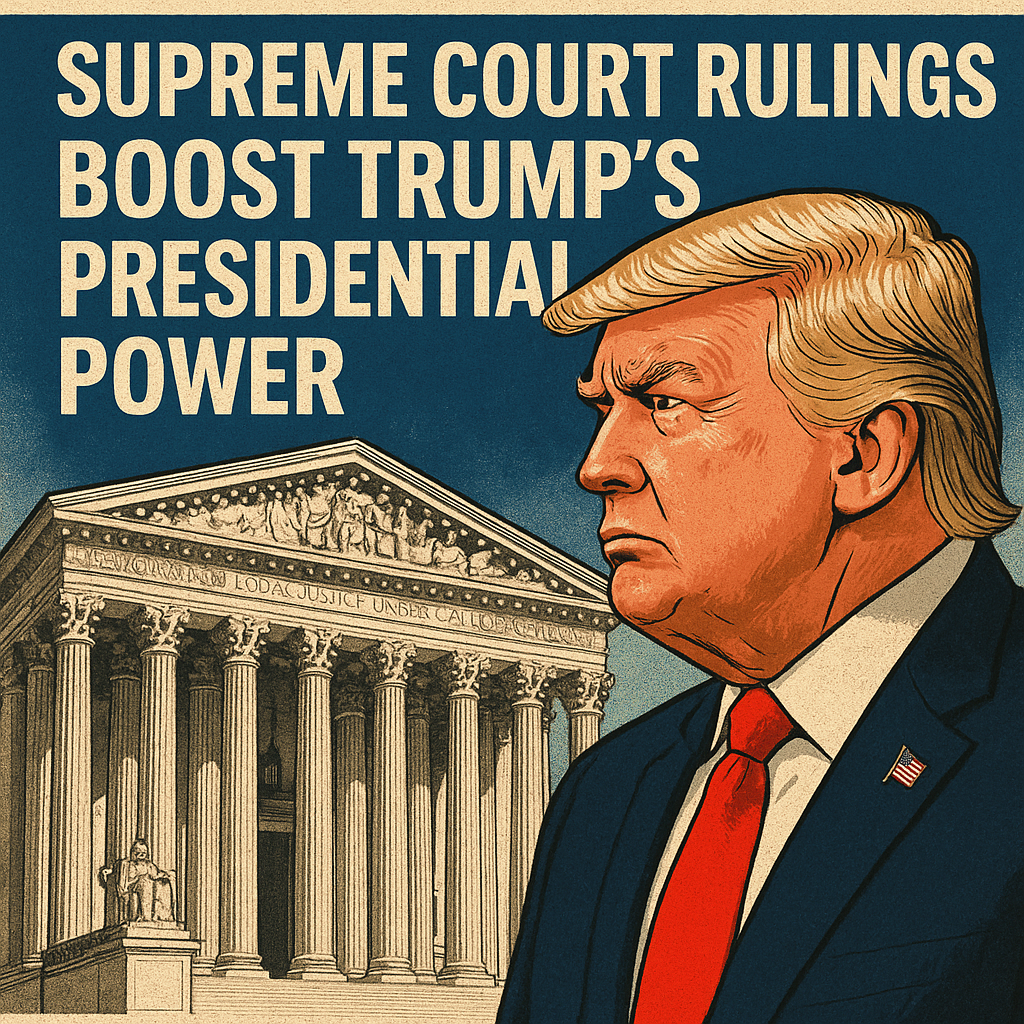
Supreme Court Rulings Boost Trump’s Presidential Power

The recent Supreme Court rulings have served to significantly bolster the presidential powers once wielded by Donald Trump during his administration. In examining the implications of these judicial decisions, it is essential to explore a diverse set of perspectives that highlight both the political ramifications and potential consequences for future governance in the United States.

Context of the Rulings
Many of the Supreme Court’s recent decisions can be seen as aligning with the principles characterized by Trump’s tenure. A particularly notable ruling involved limiting the scope of agency authority, which has been widely perceived as a means to diminish regulatory oversight—a hallmark of Trump’s push for deregulation. As reported by Al Jazeera, despite facing setbacks such as those concerning voting rights and reproductive health, the Court’s stance seems to resonate well with Trump’s vision of executive power that entails significant constraints on federal bureaucracy.


Conversely, some analysts argue that these rulings reflect a broader trend within the judiciary that transcends partisan lines. For example, one significant aspect of these decisions illustrates a willingness of the Court to prioritize state powers over federal mandates, a move that many see as empowering not just Trump, but state-level Republican leaders as well. In essence, this may lead to a more fragmented policy landscape, wherein states wield substantial authority to diverge from federal guidelines.


The Growing Power of the Presidency
The implications of these rulings extend beyond mere legal boundaries; they reshape the operational landscape for future administrations. The weakening of agency oversight may empower the presidency, allowing it to push through policies with less bureaucratic resistance. This trend could lead to significant shifts in areas like environmental regulation, healthcare, and immigration policy. As noted by Sky News, the current Court reflects a conservative ideology that intertwines with a vision for a stronger executive branch, which closely aligns with Trump’s previously implemented policies.
Such developments have reignited discussions around presidential accountability and the long-term sustainability of a power-centric executive. Critics argue that this creates a system where the presidency operates with less check on its power, raising concerns about the potential for overreach. Notably, independent watchdog organizations have expressed alarm over how these rulings may foster a climate where executive actions go unchallenged, subsequently impacting democratic norms.
Divergent Perspectives on Impacts
The trajectory toward heightened presidential authority has elicited starkly contrasting viewpoints from experts and commentators. Supporters highlight that empowering presidential discretion and minimizing bureaucratic hurdles can lead to more responsive governance. They argue that when the executive branch can act swiftly, it can better meet the fast-changing demands of the public.
On the other hand, there is significant trepidation among legal scholars and political commentators regarding the erosion of checks and balances. Critics fear that these rulings may lead to autocratic tendencies, as reflected in editorial discussions on RT News, where the framing emphasizes the potential dangers of unchecked power. They cite historical precedents where similar judicial decisions have led to abuses of authority, ultimately undermining democratic principles.
Moreover, this tension between effectiveness and accountability raises critical questions about the future landscape of American politics. Could the current Supreme Court’s rulings yield a more centralized authority devoid of sufficient oversight? Or could a larger, more responsive presidential role pave the way for increased public staunching support for necessary reforms?
Conclusion: Navigating an Uncertain Future
The interplay between Supreme Court rulings and presidential power is a complex web that demands careful consideration. While it is evident that these decisions may afford greater authority to the presidency, the question of whether this will result in constructive or destructive governance remains unanswered. The balance of power in American politics hangs precariously, with potential ramifications for both domestic and foreign affairs.
As the nation moves forward, it is imperative for citizens, lawmakers, and scholars alike to carefully monitor these developments. Engaging in robust dialogues about the implications of judicial decisions can ensure that the foundational principles of American democracy, rooted in checks and balances, remain intact in the face of evolving political realities.