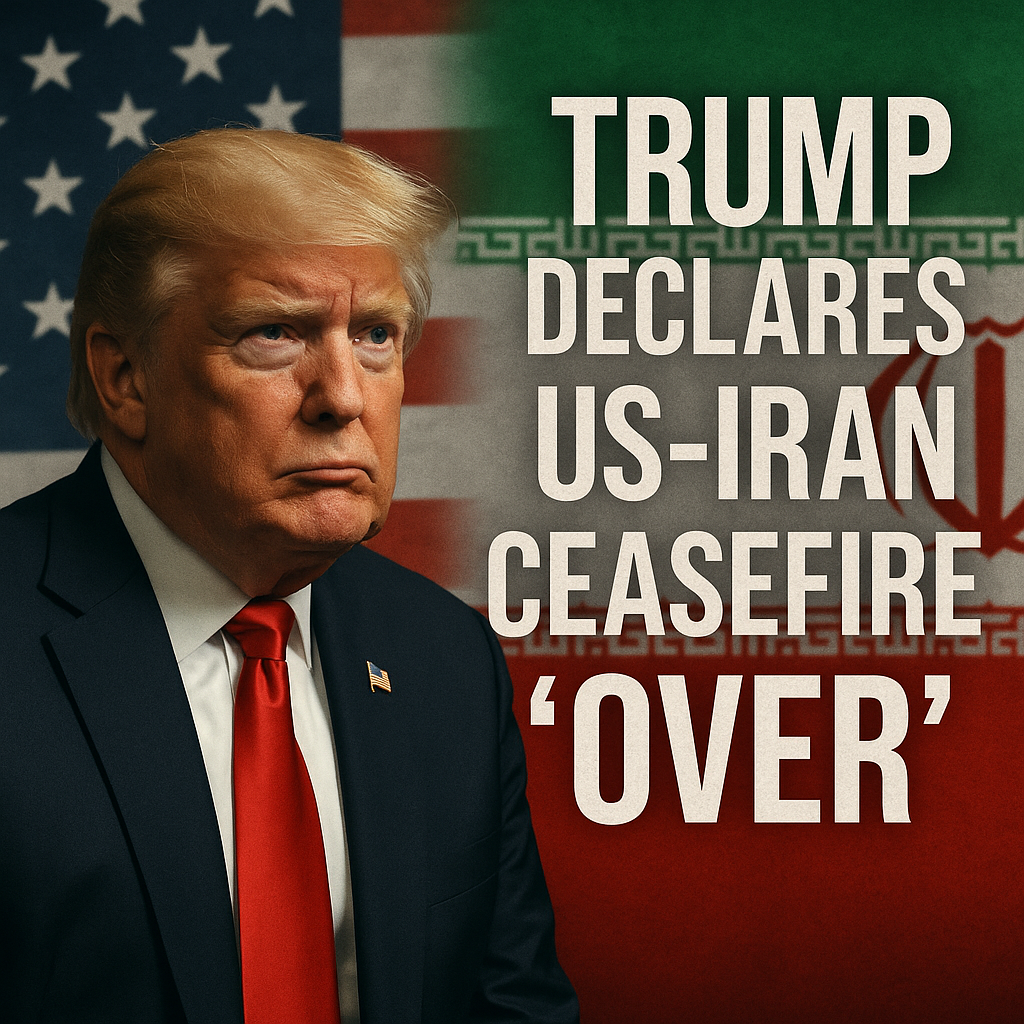
Trump Declares US-Iran Ceasefire ‘Over’

In a surprising turn of events, former President Donald Trump recently declared that the ceasefire between the United States and Iran is “over,” a statement that raises significant concerns about escalating tensions in the Middle East. This proclamation comes in the context of a complicated geopolitical landscape, one that has seen fluctuating relations between the two nations over the past few decades.

The Context of Trump’s Declaration
Trump’s statement is emblematic of his ongoing criticism of the 2015 Iran nuclear deal, formally known as the Joint Comprehensive Plan of Action (JCPOA). Under his administration, the U.S. withdrew from the agreement in 2018, triggering a cascade of reactions from Iranian officials. Following this withdrawal, tensions escalated, characterized by military confrontations, aggressive rhetoric, and a series of sanctions aimed at crippling Iran’s economy.


According to an article from RT News, Trump’s remarks signal a broader rejection of diplomatic engagement with Iran, suggesting that peace efforts have been stymied. The former president’s approach appears to be aimed at rallying his political base by framing Iran as a persistent threat to U.S. interests and national security. However, while his declaration may resonate with some domestic audiences, it raises valid concerns about its implications for international relations and regional stability.


Divergent Perspectives on U.S.-Iran Relations
Analyzing the implications of Trump’s assertion reveals a complex web of perspectives. On one hand, commentators on platforms such as Al Jazeera argue that such rhetoric risks undermining any remaining pathways for diplomacy. The outlet points out that continued hostilities could provoke retaliation from Iran, which might escalate military actions in the Gulf region. Their assessment highlights the precarious balance that the current U.S. administration must navigate: alienating allies invested in diplomatic solutions while also addressing the hardline sentiments prevalent within certain factions of U.S. politics.
Moreover, analysts note that with current geopolitical dynamics, which include issues such as Russia’s invasion of Ukraine and shifting alliances in the Middle East, there appears to be a renewed urgency for constructive dialogue. Some experts assert that continuing on the path Trump suggests could lead to greater instability not only in Iran but also throughout the region. A lack of meaningful dialogue, they argue, risks a scenario where miscalculations could spark armed conflict, exacerbating an already volatile situation.
Conversely, several commentators agree with Trump’s perspective on the limitations of diplomatic efforts. From their viewpoint, reliance on ceasefires or agreements that Iran has previously violated demonstrates a failure of traditional diplomatic strategies. Platforms like Sky News quote military analysts who warn of the possibility that Iran may take advantage of any perceived weakness from the U.S., suggesting that a firmer stance might deter Iranian provocations.
The Road Ahead: Navigating Tensions
As the U.S. grapples with Trump’s declaration, it remains unclear how the current administration will navigate the treacherous waters of U.S.-Iran relations. Secretary of State Antony Blinken has indicated that while the U.S. remains open to discussions, any future negotiations will depend on Iran’s compliance with international norms regarding nuclear proliferation and regional aggression. This position suggests a potential pivot away from Trump’s rhetoric towards a more nuanced approach that seeks to balance deterrence with diplomacy.
However, with midterm elections approaching and Trump maintaining significant influence over the Republican Party, it is likely that divisions within U.S. politics will continue to shape foreign policy decisions. As some factions push for a hardline approach, others advocate for renewed diplomacy, underscoring the need for a cohesive strategy that addresses both immediate security concerns and long-term goals for a stable Middle East.
Conclusion
In the wake of Trump’s declaration that the U.S.-Iran ceasefire is “over,” the ramifications of this statement resonate across the geopolitical landscape. As varying viewpoints on U.S.-Iran relations emerge, it is increasingly crucial for policymakers to weigh the risks of heightened tensions against the potential of meaningful diplomatic engagement. The path forward is fraught with uncertainty, yet the complexities inherent in U.S.-Iran relations demand careful navigation to avoid exacerbating existing conflicts in an already volatile region.