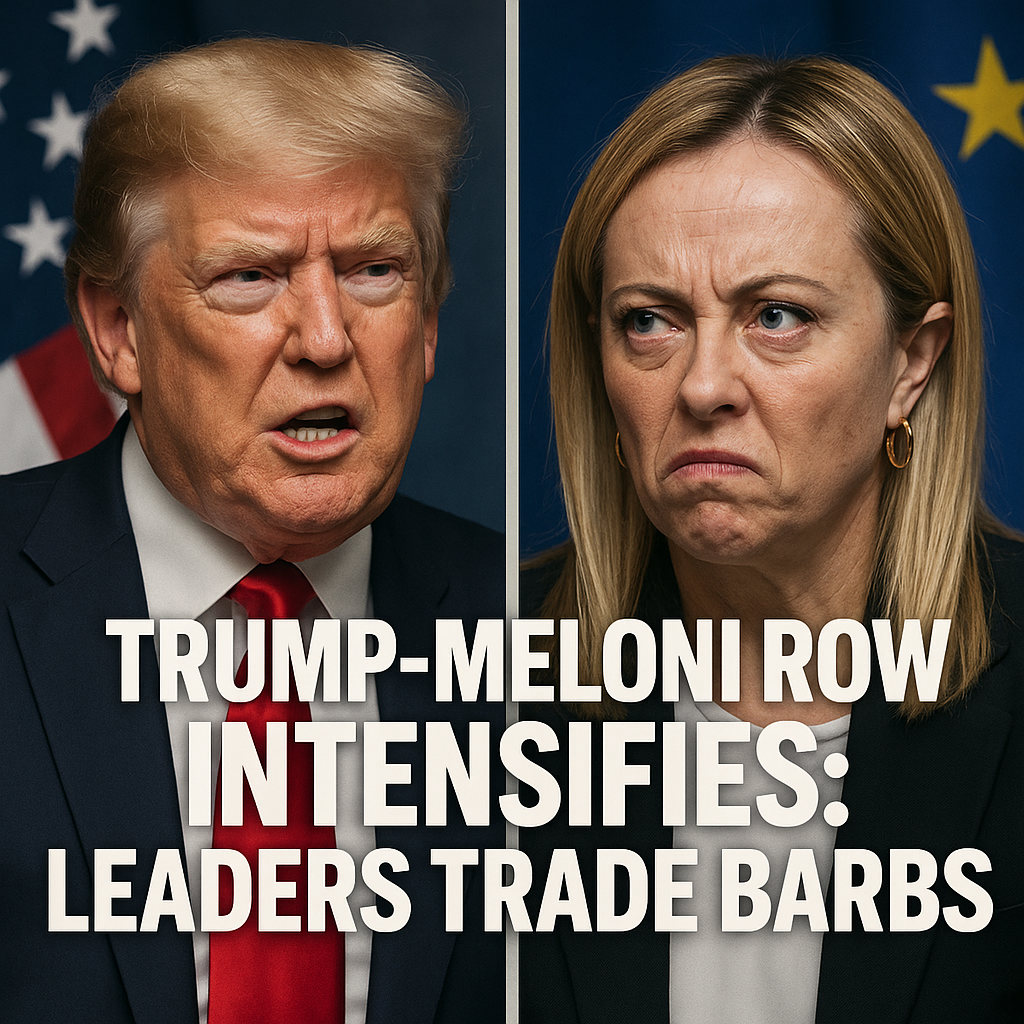
Trump-Meloni Row Intensifies: Leaders Trade Barbs

Tensions Rise: The Trump-Meloni Dispute
The ongoing feud between former President Donald Trump and Italian Prime Minister Giorgia Meloni has escalated, capturing significant media attention and raising questions about the relationship between their respective political spheres. As leaders from two of the most influential nations in their regions, their spat offers insight into broader political dynamics.

Context of the Dispute
The conflict ignited when Meloni purportedly rejected Trump’s assertion that she “begged” him for a photo at a recent event. In a statement, she clarified that such claims were “completely made up,” which sparked a heated response from Trump. He took to social media, asserting that the Italian Prime Minister was trying to “save face” in the wake of her comments. This exchange has not only fueled their rivalry but also reflects a deeper ideological clash between their governance styles, public personas, and nationalism.


The implications of this conflict are multifaceted. On one hand, Meloni, as a right-wing populist, has positioned herself as a staunch advocate of Italian sovereignty and national interests, and she seems determined to carve out a strong identity separate from her predecessors. Trump, on the other hand, has maintained his persona as a disruptive force in American politics, often leveraging controversy as a political tool.


Leadership Styles and Political Ideologies
In examining the leadership styles of Trump and Meloni, it becomes evident that both figures share a populist appeal but diverge significantly in their approach to governance and public relations.
Meloni’s Pragmatism:
Giorgia Meloni’s rise to power has been characterized by a focus on pragmatic nationalism, where she often stresses the importance of Italy’s cultural identity while advocating for traditional values. Her denial of Trump’s claims illustrates her efforts to assert authority and maintain a credible image in the international arena. Some analysts suggest Meloni might be cautious in her dealings with Trump, as she seeks to solidify her position domestically and avoid being perceived as overly influenced by foreign leaders.
Trump’s Polarizing Tactics:
Conversely, Donald Trump thrives on confrontation and polarized narratives. His ability to engage with controversy plays a pivotal role in attracting media attention and energizing his base. The former president’s response to Meloni’s denial not only amplified his voice within America but also set the stage for ongoing rhetoric that may destabilize his relationship with European allies. His penchant for blunt statements often transcends diplomatic norms, raising questions over what constitutes acceptable discourse on the global stage.
The Broader Implications
The back-and-forth between the two leaders extends beyond personal disagreements. It serves as a microcosm of the evolving landscape of international politics where relationships can pivot quickly based on individual personas. Observers have pointed out that this clash could have repercussions for future collaborations between the United States and Italy, particularly concerning shared interests on issues such as migration, economic policies, and security.
Moreover, polls suggest that both leaders enjoy significant support within their respective bases, underscoring how personality-driven politics has become quintessential to modern governance. Meloni’s resolve in upholding national priorities has appealed to a portion of the Italian electorate that is wary of perceived foreign interference. In counterpoint, Trump’s resonance among American voters hinges on his anti-establishment rhetoric and fierce opposition to traditional political norms.
Closing Thoughts
As the Trump-Meloni row intensifies, it highlights the complexities surrounding modern leadership and the interplay of national identities. While Meloni and Trump may share ideological common ground, their varying approaches to leadership reveal the inherent tensions in their political relationship. Whether this dispute leads to further diplomatic estrangement or simply serves as a temporary headline is uncertain. For now, observers will be keenly watching how each leader navigates the tumultuous waters of public perception and international diplomacy—each seeking to maintain their standing while asserting their unique vision of governance.