
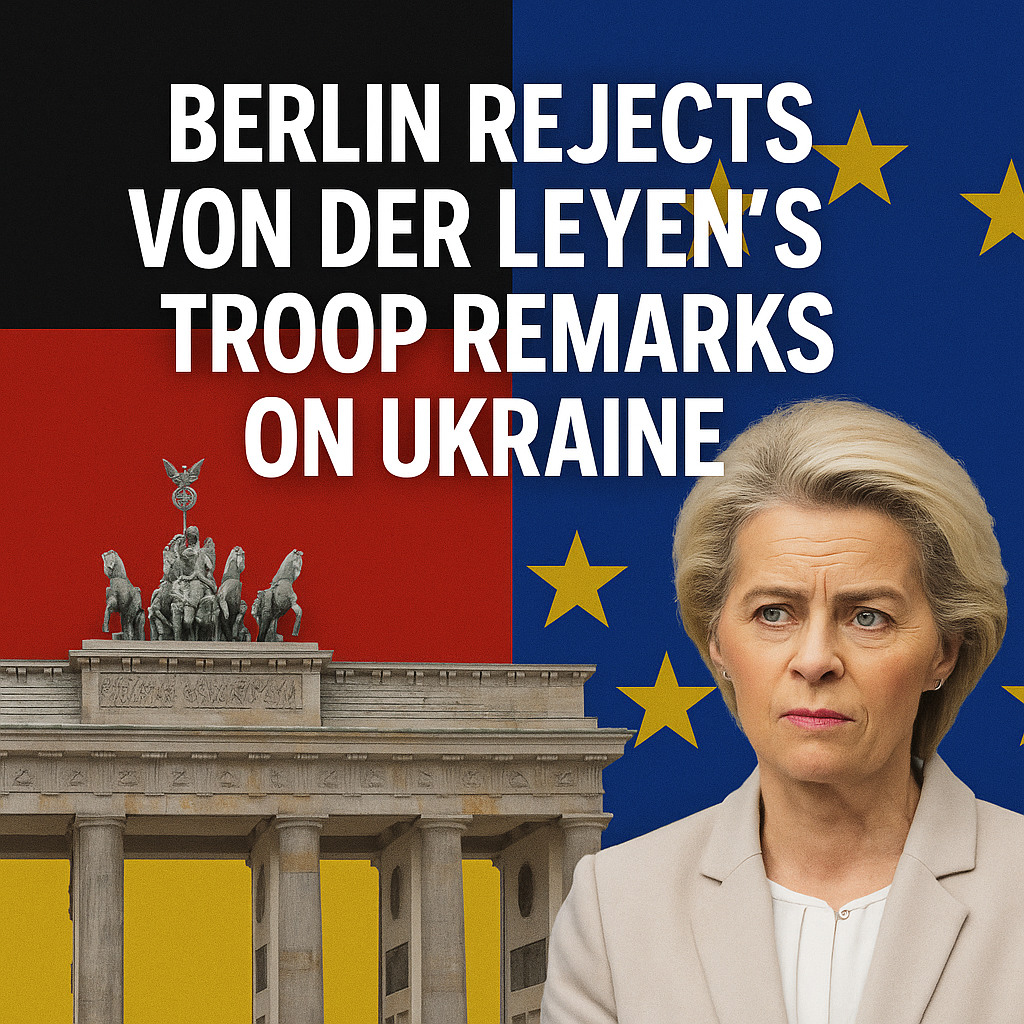
Berlin Rejects von der Leyen’s Troop Remarks on Ukraine

Berlin Rejects von der Leyen’s Troop Remarks on Ukraine
Berlin has made notable headlines recently by rejecting remarks made by Ursula von der Leyen, the President of the European Commission, regarding troop arrangements in Ukraine. This divergence of opinions highlights the complex dynamics of European security and defense policies amidst an ongoing conflict.

The Context of the Disagreement
Von der Leyen suggested that EU member states should consider deploying troops to Ukraine, emphasizing the need for increased military support to combat Russian aggression. She posited that the security of Europe directly correlates with the stability of Ukraine, and argued for collective action among EU nations.


However, Berlin has distanced itself from these comments. German officials have reiterated their commitment to supporting Ukraine but have made it clear that they do not seek a direct military intervention. Germany’s position reflects its strategic caution following historical experiences and current geopolitical tensions.


An Analysis of Perspectives
The core of the disagreement lies in contrasting approaches to European defense. Supporters of von der Leyen’s stance argue that a unified military presence not only deters further Russian advances but also strengthens the EU’s collective security. For instance, advocates from Eastern European countries, who are particularly threatened by Russia, see troop deployments as a necessity for demonstrating strength and solidarity.
On the contrary, Germany’s hesitation showcases its preference for diplomatic measures over militaristic solutions. Berlin has been historically wary of deploying troops beyond its borders, particularly given its post-World War II pacifist policy. German Foreign Minister Annalena Baerbock reinforced this notion, stating that “our focus remains on supporting Ukraine through arms and financial aid, but direct troop involvement requires a different level of deliberation.”
The Broader Implications for European Security
This disagreement is more than a simple diplomatic spat; it is indicative of the larger strategic philosophies within the EU regarding military engagement. Germany’s reluctance also raises questions about the potential for fraying unity among member states in response to external threats. These internal divisions can complicate decision-making processes at a crucial moment when solidarity is paramount.
Interestingly, a middle ground is emerging where nations are emphasizing enhanced military cooperation without committing to troop deployments. This includes discussions around increasing joint military exercises and intelligence sharing, aiming to improve readiness without taking provocative steps that could escalate tensions with Russia.
Points of Consensus and Divergence
Even amid these contrasting views, there remains an underlying consensus on the necessity of support for Ukraine. Both sides acknowledge the importance of military and financial assistance in bolstering Ukraine’s defense against ongoing Russian offensives. The challenge lies in articulating what that assistance should look like.
Germany’s emphasis on caution does not equate to disengagement; rather, it reflects a nuanced stance that prioritizes stability and peace in the region. Meanwhile, von der Leyen’s push for a more proactive military posture may stem from a desire for a unified EU response to perceived threats—a sentiment echoed by several member states bordering Russia.
Future Prospects for EU Defense Collaboration
As the situation in Ukraine continues to evolve, it will be imperative for the EU to recalibrate its defense strategies. The broader question remains: how can Europe present a united front without overstepping boundaries that might provoke further conflict?
Reports indicate that upcoming EU summits will likely address these concerns more directly, focusing on establishing a clearer framework for cooperative defense that balances military readiness with diplomatic restraint.
In summary, while Berlin’s rejection of Ursula von der Leyen’s troop comments underscores significant strategic differences, it also opens up necessary dialogues about the form and nature of European support for Ukraine. The path forward will require compromise, a commitment to NATO principles, and an understanding of the complex geopolitical landscape that defines modern Europe.
As this situation unfolds, the ability of EU nations to navigate their varying perspectives will be crucial in determining not only the future of Ukraine but also the cohesion of the European Union itself.















