
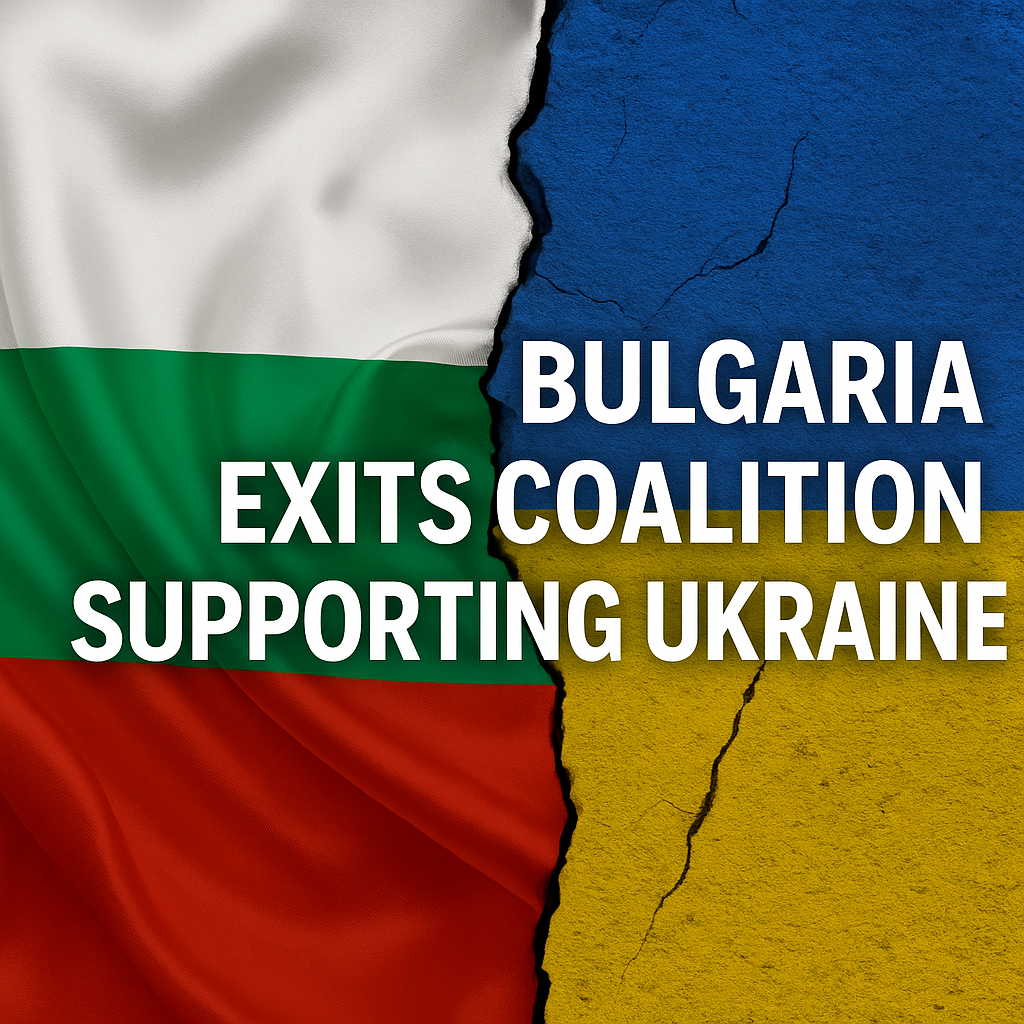
Bulgaria Exits Coalition Supporting Ukraine
Bulgaria Exits Coalition Supporting Ukraine
In a significant turn of events, Bulgaria has announced its departure from the coalition supporting Ukraine amidst ongoing tensions due to the Russian invasion. This decision has stirred a complex dialogue among political analysts, with implications not just for Bulgaria but for the broader geopolitical landscape in Eastern Europe.

Political Context and Implications
Bulgaria’s exit from the coalition can be attributed to internal political dynamics as well as external geopolitical pressures. President Rumen Radev, a key player in this decision, emphasized that Bulgaria’s stance must align with its national interests, suggesting a shift toward neutrality. This change comes as various factions within Bulgaria express differing views on the ongoing war in Ukraine and the best approach for Bulgarian foreign policy.

Political analysts have noted that Bulgaria has historically had strong ties with Russia, dating back to the Soviet era. Radev’s administration, which has faced criticism for its pro-Western policies, may now be recalibrating its position in light of increased domestic dissent. Reports indicate that many Bulgarians are concerned about economic ramifications and the influx of refugees from Ukraine, which has only fueled calls for a reassessment of foreign policy priorities.

Diverging Viewpoints Among Regional Leaders
The reaction across Eastern Europe to Bulgaria’s decision has been mixed. Some leaders express concern that Bulgaria’s exit might embolden Russia, while others argue that it reflects the growing sentiment in some countries that they should prioritize national interests over collective pacts.
For instance, leaders in Poland and the Baltic states have reiterated their commitment to supporting Ukraine, underscoring an unwavering alliance against Russian aggression. These countries view solidarity as essential for regional stability and warn that any sign of division could potentially encourage further Russian incursions. Conversely, other nations in the region are beginning to voice similar sentiments as Bulgaria, prioritizing their own economic stability and security.
Economic Factors at Play
Economically, Bulgaria’s decision is influenced by several factors, including energy dependence on Russia and economic growth concerns. Analysts believe that increased sanctions against Russia have upset Bulgaria’s economic equilibrium, thus prompting a reevaluation of its cooperation with Western allies. The older, more pro-Russian demographics in Bulgaria reflect skepticism over policies seen as detrimental to the Bulgarian economy.
The implications of this pivot are manifold. For one, Bulgaria might seek to negotiate a more favorable energy deal with Russia or explore alternative suppliers. Bulgaria’s exit from the coalition does not preclude its involvement in any future dialogues concerning Ukraine; rather, it opens a door for different forms of engagement that could prioritize Bulgarian interests.
The Broader European Landscape
As Bulgaria moves away from a strong commitment to Ukraine, the European Union’s unified front against Russian aggression faces its test. The EU is grappling with rising internal pressures from member states that are questioning the sustainability of prolonged support for Ukraine without tangible benefits. This divergence emphasizes a crucial point: unity in action is critical, but domestic realities can challenge collective resolutions.
Experts warn against a simplistic interpretation of Bulgaria’s exit as merely a sign of weakness in Ukraine’s support. Instead, it serves as a reflection of evolving geopolitical considerations, where national sovereignty and internal priorities will increasingly dictate foreign policy decisions.
Conclusion: Navigating Complexity in Foreign Policy
In summary, Bulgaria’s exit from the coalition supporting Ukraine illustrates the complexities of modern geopolitics. The diverse views surrounding this decision highlight the tension between national interests and collective security arrangements. As countries navigate these intricate dynamics, it becomes essential for leaders to balance internal pressures with their roles on the international stage. The future of Bulgaria’s involvement in the broader coalition will likely hinge not just on its own political will but also on the evolving landscape of Eastern European alliances and Russia’s strategic moves in the region.
As Bulgaria embarks on this new course, many will be watching closely to see how this decision affects not only its national interests but also the collective efforts to support Ukraine amidst ongoing challenges and uncertainties.















